Support our educational content for free when you purchase through links on our site. Learn more
🐷 Animal Farm Book Summary SparkNotes: Full Guide

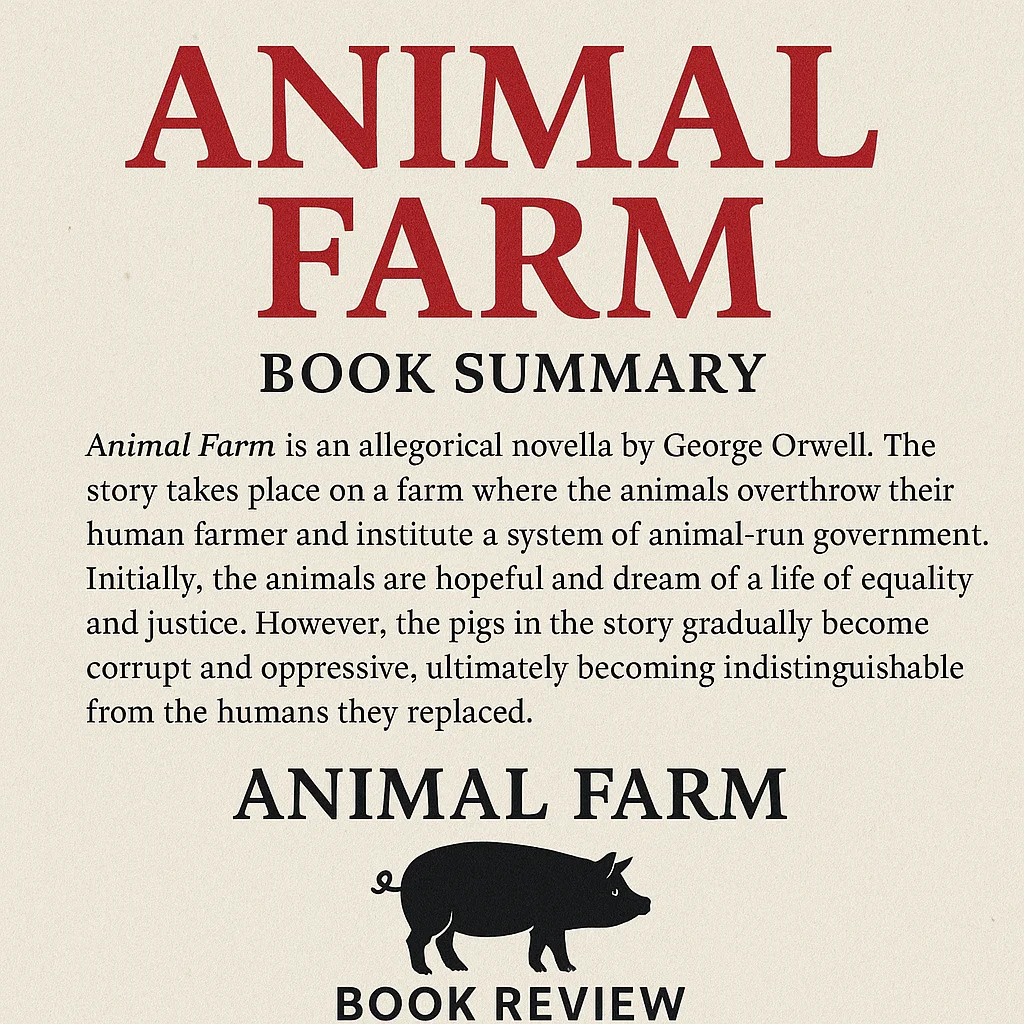
The best Animal Farm book summary SparkNotes alternative is a concise plot overview paired with character symbolism, historical context, themes, and quote analysis. George Orwell’s novella is not simply about rebellious farm animals; it is a warning about how revolutions can be hijacked when leaders control education, language, and force.
Our guide follows the animals from Old Major’s dream of equality to Napoleon’s dictatorship and the unforgettable ending where pigs and humans become indistinguishable. It also explains the Russian Revolution parallels, so you can study smarter instead of memorizing a stampede of disconnected names.
I still remember the first time Boxer’s fate made the story feel less like a fable and more like a political gut punch. His repeated promise, “I will work harder,” sounds noble at first, but Orwell gradually turns it into a warning: hard work cannot protect people from a system designed to exploit them.
The novel was published in 1945 and draws heavily on the Russian Revolution and Stalin’s rise to power. Orwell’s political allegory remains remarkably readable because every major idea arrives wearing a costume: propaganda becomes Squealer, repression becomes the dogs, and inequality eventually learns to walk on two legs.
Key Takeaways
- Plot: The animals overthrow Mr. Jones, but Napoleon gradually transforms Animal Farm into another authoritarian regime.
- Main message: Power can corrupt revolutionary ideals when leaders face no accountability.
- Historical allegory: Napoleon parallels Joseph Stalin, Snowball resembles Leon Trotsky, and Boxer represents exploited workers.
- Seven Commandments: Their gradual alteration shows how rulers manipulate language and rewrite history.
- Major themes: Propaganda, class inequality, literacy, political betrayal, fear, and totalitarianism.
- Boxer’s fate: His exploitation proves that loyalty and hard work cannot replace rights or independent judgment.
- Ending: The pigs become indistinguishable from humans, revealing that the revolution has recreated the hierarchy it promised to destroy.
- Best study strategy: Track who controls food, education, force, and information at each stage of the story.
Table of Contents
- ⚡️ Quick Tips and Facts: Animal Farm at a Glance
- 📚 Animal Farm Book Summary: Plot Overview
- The Manor Farm Rebellion Begins
- The Animals Build Animal Farm
- Snowball, Napoleon, and the Battle for Power
- The Windmill, Propaganda, and Political Control
- The Purges, Broken Commandments, and Final Betrayal
- 🧭 George Orwell and the Historical Background of Animal Farm
- The Russian Revolution and Soviet Union Connection
- Stalinism, Totalitarianism, and Political Allegory
- Why Orwell Wrote Animal Farm
- 👥 Animal Farm Characters and Their Symbolic Meanings
- Old Major: Revolutionary Visionary
- Napoleon: Dictator and Political Tyrant
- Snowball: Idealist and Rival Revolutionary
- Boxer: The Exploited Working Class
- Squealer: Propaganda and Manipulation
- Benjamin: Cynicism, Knowledge, and Silence
- Clover, Mollie, Moses, and the Sheep
- Mr. Jones, Mr. Frederick, and Mr. Pilkington
- 🔍 Animal Farm Chapter-by-Chapter Summary
- Chapter 1: Old Major’s Speech
- Chapter 2: Rebellion and the Seven Commandments
- Chapter 3: Work, Literacy, and Unequal Leadership
- Chapter 4: The Battle of the Cowshed
- Chapter 5: Snowball’s Expulsion
- Chapter 6: The Windmill and the First Broken Commandment
- Chapter 7: Famine, Fear, and the Hen Rebellion
- Chapter 8: Napoleon’s Cult of Personality
- Chapter 9: Boxer’s Exploitation
- Chapter 10: The Final Transformation
- 🎭 The Seven Commandments: Original Rules and Altered Meanings
- What the Commandments Represent
- How Napoleon’s Regime Rewrites History
- “All Animals Are Equal” Explained
- 💡 Major Themes in Animal Farm
- Power Corupts and Absolute Power Corupts Absolutely
- Propaganda, Language, and Misinformation
- Class Exploitation and Social Inequality
- Education, Illiteracy, and Political Control
- Revolution, Betrayal, and the Loss of Ideals
- Fear, Violence, and Totalitarian Government
- Hope, Resistance, and Political Silence
- 🧠 Animal Farm Literary Devices and Writing Techniques
- Alegory and Satire
- Irony and Dramatic Contrast
- Foreshadowing and Repetition
- Symbolism of the Windmill, Barn, and Commandments
- Songs, Slogans, and Repeated Phrases
- 📝 Important Quotes from Animal Farm Explained
- “Man Is the Only Real Enemy We Have”
- “Four Legs Good, Two Legs Bad”
- “I Will Work Harder”
- “Napoleon Is Always Right”
- “All Animals Are Equal, but Some Animals Are More Equal Than Others”
- ⚖️ Animal Farm Political Allegory: Character-to-History Comparison
- Napoleon and Joseph Stalin
- Snowball and Leon Trotsky
- Old Major, Karl Marx, and Vladimir Lenin
- Boxer and the Soviet Working Class
- The Animals and the Russian Revolution
- 🚫 When CliffsNotes Is Unavailable: A Better Animal Farm Study Guide
- How to Use a Summary Without Missing the Meaning
- Summary Versus Analysis: What Your Teacher Expects
- Common Study Mistakes to Avoid
- 🎓 How to Analyze Animal Farm for an Essay or Exam
- How to Write a Strong Thesis Statement
- Essay Questions and Discussion Prompts
- Evidence for Character and Theme Analysis
- Sample Analytical Essay Outline
- ✅ What Animal Farm Teaches Readers Today
- Warning Signs of Authoritarian Leadership
- Why the Novel Remains Relevant
- Lessons About Media Literacy and Civic Responsibility
- ❓ Frequently Asked Questions About Animal Farm
- 🏁 Conclusion
- 🔗 Recommended Links
- 📖 FAQ
- 🔎 Reference Links
⚡️ Quick Tips and Facts: Animal Farm at a Glance
If you need the fast version before wrestling with the pigs, here it is: George Orwell’s Animal Farm is a political allegory about a revolution that promises equality but becomes another dictatorship. For a fuller Animal Farm book summary, keep this central question in mind: How does a movement created to destroy oppression end up rebuilding it?
| Fact | Answer |
|---|---|
| Author | George Orwell, pen name of Eric Arthur Blair |
| Published | 1945 |
| Genre | Allegorical novella, political satire, dystopian fiction |
| Setting | Manor Farm, later renamed Animal Farm |
| Narrator | Third-person narrator |
| Central conflict | The animals’ revolution versus the pigs’ growing dictatorship |
| Main antagonist | Napoleon, supported by the dogs and Squealer |
| Historical focus | The Russian Revolution and the rise of Stalinism |
| Core themes | Power, propaganda, inequality, literacy, fear, political betrayal |
| Most famous line | “All animals are equal, but some animals are more equal than others.” |
| Ending | The pigs become indistinguishable from the humans they replaced |
The 60-second plot summary
- Old Major, an aging pig, inspires the animals to rebel against Mr. Jones.
- The animals overthrow Jones and rename the property Animal Farm.
- They establish the Seven Commandments, promising a society based on equality.
- Napoleon gradually takes control, using trained dogs, propaganda, and fear.
- He expels Snowball, rewrites history, and blames every setback on his former rival.
- The animals work harder while the pigs enjoy privileges.
- By the final scene, the pigs walk on two legs and socialize with humans.
- The animals look from pig to man and man to pig, unable to tell the difference.
Three study tips that save time 📖
- Track changes in language. The commandments reveal the political collapse more clearly than any speech.
- Compare promises with outcomes. The animals are told they are building freedom; their labor and food tell a different story.
- Separate Orwell’s criticism of ideals from his criticism of betrayal. Orwell was a democratic socialist who opposed totalitarianism, not a writer attacking every idea associated with socialism. The George Orwell Foundation provides useful background on his political commitments.
Quick warning: A plot summary tells you what happens. An analysis explains why the animals accept it for so long. That second question is where the real teeth are.
📚 Animal Farm Book Summary: Plot Overview
The story begins at Manor Farm, where the animals endure hunger, overwork, and neglect under the farmer Mr. Jones. Their dissatisfaction becomes a political movement after Old Major describes a future without human masters.
At first, the rebellion appears successful. The animals work together, produce their own food, and replace human authority with collective rules. Yet the revolution has a built-in weakness: the animals do not share equal access to education, information, or power.
The pigs can read and organize. Most other animals cannot. That gap allows Napoleon and Squealer to transform leadership into domination.
The Manor Farm Rebellion Begins
Old Major gathers the animals in the barn and explains that humans are the source of their suffering. His speech combines a moral argument with a practical one:
- Humans consume without producing.
- Animals perform the labor.
- Animals receive inadequate food and security.
- The animals’ lives are shortened or discarded when they are no longer useful.
Old Major’s revolutionary song, “Beasts of England,” gives the animals a shared emotional identity. Songs, slogans, and rituals matter because political movements are not built from facts alone. They are built from belonging.
The historical parallel is strong. The Encyclopaedia Britannica overview of the Russian Revolution explains how the 1917 upheavals ended imperial rule and led to a new political order. Orwell compresses that complicated history into a farmyard rebellion, making the political mechanics easy to see.
Why Old Major matters
Old Major dies before the rebellion, but his ideas become the foundation of Animalism. He represents a blend of:
- Karl Marx, whose critique of class exploitation inspires revolution.
- Vladimir Lenin, whose revolutionary leadership helps transform theory into political action.
The comparison is useful, but not perfectly one-to-one. Literary allegories are maps, not satellite photographs. Old Major is a symbolic starting point, not a complete biography of either historical figure.
The Animals Build Animal Farm
After Jones neglects the animals and fails to feed them, they break into the store shed. Jones and his men attempt to regain control, but the animals drive them off the property.
The victory is exhilarating:
- The farm is renamed Animal Farm.
- Human tools of domination are destroyed or rejected.
- The Seven Commandments are painted on the barn wall.
- The harvest is completed collectively.
- The animals believe their work finally belongs to them.
The revolution’s first success shows why political promises can be powerful. The animals are not foolish for wanting change. Their grievances are real.
The trouble begins when the pigs quietly claim the milk and apples. Squealer argues that the pigs need these foods to preserve their health because they are “brainworkers.” The explanation sounds practical, but it establishes a dangerous principle: the leaders may receive special treatment because they claim to serve everyone else.
Snowball, Napoleon, and the Battle for Power
Snowball and Napoleon emerge as the farm’s leading pigs. They disagree about strategy:
| Issue | Snowball | Napoleon |
|---|---|---|
| Leadership style | Persuasive and public | Secretive and coercive |
| Main project | The windmill | Control of the farm |
| Political method | Debate and education | Dogs, propaganda, and intimidation |
| Relationship with the animals | Appeals to ideals | Demands obedience |
| Historical association | Leon Trotsky | Joseph Stalin |
Snowball proposes building a windmill to generate electricity and reduce labor. Napoleon appears to oppose the plan, but his behavior is more calculated than principled. He raises and trains nine puppies in private.
When the dogs mature, Napoleon uses them to chase Snowball off the farm. The debate ends not with a vote but with violence.
This is the story’s decisive turning point. Before Snowball’s expulsion, the animals still possess a political process, however messy. Afterward, Napoleon rules through manufactured consensus.
The Battle of the Cowshed
Mr. Jones returns with other men to retake the farm. Snowball organizes the defense, and the animals defeat the attackers.
The battle matters for two reasons:
- It proves that the animals can defend themselves.
- It creates a heroic past that Napoleon later manipulates.
Snowball’s bravery becomes inconvenient because it gives the expelled pig legitimate status. Napoleon therefore begins revising the animals’ memories. Squealer claims Snowball was secretly collaborating with Jones all along.
The animals remember Snowball fighting in the battle, but they lack written records and confidence in their own memories. That uncertainty allows propaganda to overpower experience.
The Windmill, Propaganda, and Political Control
After Snowball’s expulsion, Napoleon announces that the windmill will be built after all. The animals are confused, but Squealer insists Napoleon never truly opposed it.
This is a small but revealing example of historical revision. Napoleon does not merely change policy; he changes what everyone is expected to remember about the policy.
The windmill becomes several things at once:
- A promise of a better future.
- A symbol of technological progress.
- A source of exhausting labor.
- A convenient explanation for food shortages.
- A political trophy that Napoleon can claim as his own.
The animals rebuild it repeatedly. Each time it collapses, Snowball is blamed. The enemy becomes invisible, but politically useful.
Squealer’s propaganda toolkit
Squealer manipulates the animals through:
- Statistics: He announces improved production figures even when the animals are hungry.
- Fear: He asks whether the animals want Jones back.
- False expertise: He presents invented data as unquestionable truth.
- Selective memory: He insists the animals remember events incorrectly.
- Slogans: He reduces complicated decisions to easy phrases.
- Personal flattery: He treats Napoleon’s choices as evidence of genius.
The Library of Congress discussion of propaganda offers useful context for understanding how persuasive messages can simplify information, appeal to emotion, and shape public behavior.
The Purges, Broken Commandments, and Final Betrayal
Napoleon’s rule becomes openly violent. Animals confess to invented crimes and are executed by the dogs. The atmosphere shifts from revolutionary hope to political terror.
The Seven Commandments are gradually altered:
- “No animal shall sleep in a bed” becomes “No animal shall sleep in a bed with sheets.”
- “No animal shall drink alcohol” becomes “No animal shall drink alcohol to excess.”
- “No animal shall kill any other animal” becomes “No animal shall kill any other animal without cause.”
Each revision appears minor. Together, they show the destruction of law. The commandments no longer restrain power; they decorate it.
Boxer continues working, repeating:
- “I will work harder.”
- “Napoleon is always right.”
His loyalty is admirable as a personal quality but disastrous as a political habit. He substitutes obedience for judgment, and the farm eventually treats him as a disposable resource.
When Boxer collapses, Napoleon sends him to a knacker rather than to a veterinary hospital. Squealer later claims the truck belonged to a veterinarian and that Boxer died peacefully. The animals want to believe him because the truth is unbearable.
The final betrayal arrives when the pigs walk upright. The sheep change their slogan from “Four legs good, two legs bad” to “Four legs good, two legs better!” The animals look through the farmhouse window and see pigs and humans drinking together.
The revolution has not simply failed. It has reproduced the structure it promised to destroy.
🧭 George Orwell and the Historical Background of Animal Farm

George Orwell wrote Animal Farm between 1943 and 194, during the Second World War, when the Soviet Union was an ally of Britain against Nazi Germany. That political context helps explain why publishing the book was difficult: criticism of Stalin could be treated as inconvenient, divisive, or even dangerous.
The Orwell Foundation biography confirms that Orwell’s experiences with imperialism, poverty, class inequality, and the Spanish Civil War shaped his political writing.
The Russian Revolution and Soviet Union Connection
The novel follows a simplified historical sequence:
| Animal Farm event | Historical parallel |
|---|---|
| Mr. Jones’s rule | Tsar Nicholas II and imperial autocracy |
| Old Major’s revolutionary ideas | Marxist theory and Leninist revolutionary thought |
| The animals’ rebellion | Russian Revolution of 1917 |
| Snowball’s expulsion | Leon Trotsky’s exile |
| Napoleon’s dictatorship | Joseph Stalin’s consolidation of power |
| The dogs | Secret police and political repression |
| Confessions and executions | Stalinist purges |
| Windmill projects | Industrialization and forced labor |
| Boxer’s fate | Exploited workers and peasants |
| Pig-human cooperation | Soviet diplomatic and political compromises |
The U.S. State Department’s Office of the Historian describes the Russian Revolution as a process involving the collapse of monarchy, the provisional government, and the Bolshevik seizure of power. Orwell compresses these stages, but the moral pattern remains visible: a revolution may replace rulers without abolishing hierarchy.
Stalinism, Totalitarianism, and Political Allegory
Stalin’s government used censorship, surveillance, propaganda, forced collectivization, and purges. Orwell transforms those mechanisms into animal behavior:
- Dogs enforce Napoleon’s authority.
- Squealer manages public belief.
- The sheep drown out serious discussion.
- The pigs control written law.
- Snowball becomes a permanent scapegoat.
- Boxer’s labor is praised until his body fails.
The novel is often described as a critique of communism. That wording needs precision. Orwell’s target is especially the corruption of revolutionary socialism into authoritarian Stalinism. The story attacks a ruling elite that claims to represent workers while exploiting them.
This distinction matters because Orwell himself identified as a democratic socialist. The Orwell Foundation’s political overview helps explain his concern with political language and the relationship between art and ideology.
Why Orwell Wrote Animal Farm
Orwell wanted political writing to be clear enough for ordinary readers. The farm setting gives the novel a deceptively simple surface. Children can follow the animals; adults can recognize the political machinery underneath.
The book’s effectiveness comes from contrast:
- A cheerful slogan hides coercion.
- A patriotic song hides exploitation.
- A production report hides hunger.
- A commandment hides dictatorship.
- A heroic leader hides a frightened tyrant.
That is why the novella remains so teachable. It gives abstract concepts—propaganda, totalitarianism, revisionism—a face, a hoof, or a suspiciously well-fed pig.
👥 Animal Farm Characters and Their Symbolic Meanings
The characters operate on two levels. They are animals with personalities, and they are political symbols. Treating them as only one or the other flattens the story.
Old Major: Revolutionary Visionary
Old Major speaks with moral authority. He sees exploitation clearly and gives the animals a vision of a society without human masters.
Symbolic role:
- Revolutionary theory
- Marxist critique of class exploitation
- Hope for a more equal society
- The emotional power of a founding myth
Strength: He identifies genuine injustice.
Limitation: His vision does not explain how power should be distributed after the revolution. The animals inherit ideals but not a reliable system for protecting them.
Napoleon: Dictator and Political Tyrant
Napoleon is not charismatic in the way Snowball is. His power comes from patience, secrecy, and organization. He understands that controlling force and information matters more than winning arguments.
Napoleon’s methods include:
- Raising the puppies in secret.
- Eliminating political opposition.
- Rewriting the past.
- Rewarding loyalists.
- Using fear to suppress questions.
- Turning himself into a symbol of success.
- Accepting the privileges once condemned.
Napoleon represents Stalin, but he also represents a broader pattern: the leader who claims to embody the revolution while making the revolution impossible to question.
Snowball: Idealist and Rival Revolutionary
Snowball is energetic, imaginative, and committed to education. He wants the animals to learn and believes technology could improve their lives.
His weaknesses are equally important:
- He is too confident in rational debate.
- He does not fully anticipate Napoleon’s use of violence.
- He assumes shared revolutionary goals will restrain political ambition.
- His plans may be visionary but depend on trust institutions that do not yet exist.
Snowball’s expulsion shows that a good argument cannot survive when one side controls the dogs.
Boxer: The Exploited Working Class
Boxer is physically powerful, loyal, and emotionally generous. He believes that more labor will solve every problem.
His two slogans are tragic because they replace independent thinking:
- “I will work harder.”
- “Napoleon is always right.”
Boxer symbolizes the workers whose labor sustains the state but who have limited access to education or political power. His fate exposes the gap between official praise and actual value.
A state can call workers heroes while treating them as equipment. That is Boxer’s heartbreak—and the farm’s accounting system.
Squealer: Propaganda and Manipulation
Squealer rarely creates policy. He makes policy sound reasonable after Napoleon has already chosen it.
| Propaganda technique | Example in the novel |
|---|---|
| Fear appeal | “Do you want Jones back?” |
| False statistics | Claims of rising production |
| Confident delivery | Says impossible claims as facts |
| Language distortion | Reinterprets the commandments |
| Personal worship | Praises Napoleon’s wisdom |
| Historical revision | Recasts Snowball as a traitor |
Squealer’s power depends on the animals’ uneven literacy. A population does not need to be completely ignorant for propaganda to work; it only needs to lack reliable ways to check claims.
Benjamin: Cynicism, Knowledge, and Silence
Benjamin the donkey can read, but he rarely acts. He understands more than most animals yet refuses to believe change is possible.
His silence raises an uncomfortable question: Is seeing the truth enough?
Benjamin eventually responds when Boxer is taken away, but his resistance comes too late. Orwell does not present cynical awareness as a sufficient virtue. Knowledge without action can leave power untouched.
Clover, Mollie, Moses, and the Sheep
Clover
Clover represents compassionate workers who sense that the revolution has gone wrong but cannot fully articulate why. She notices that the commandments have changed, yet she lacks the literacy or confidence to challenge the official version.
Mollie
Mollie loves ribbons, sugar, and comfort. She leaves the farm for a human owner. Her character can symbolize:
- The privileged class unwilling to sacrifice comfort.
- People who reject revolution when it threatens personal luxury.
- The limits of political loyalty based solely on material benefits.
Moses
Moses, the raven, tells stories about Sugarcandy Mountain, a paradise after death. Napoleon first suppresses Moses, then allows him to return when his story becomes useful.
Moses represents organized religion as a potential source of consolation. His story may comfort the oppressed, but it can also redirect attention away from injustice in the present.
The Sheep
The sheep reduce political ideas to chants. They are not evil; they are politically manipulated. Their repeated slogans prevent discussion and make disagreement sound unnatural.
When they shift from “two legs bad” to “two legs better,” the speed of the change reveals how easily mass language can be redirected.
Mr. Jones, Mr. Frederick, and Mr. Pilkington
- Mr. Jones represents the old ruling order: negligent, entitled, and unable to understand why the animals revolt.
- Mr. Frederick represents aggressive authoritarian power, often associated with Adolf Hitler and Nazi Germany.
- Mr. Pilkington represents established capitalist powers, particularly Britain, who may criticize dictatorship while pursuing their own interests.
The human farmers are not presented as moral heroes. Orwell’s point is sharper: the failure of one oppressive system does not guarantee the virtue of its replacement.
🔍 Animal Farm Chapter-by-Chapter Summary
The novella is commonly divided into ten chapters. Chapter numbering can vary slightly by edition formatting, but the plot sequence remains consistent.
Chapter 1: Old Major’s Speech
Old Major summons the animals to the barn and describes the injustice of human ownership. He argues that animals produce everything but receive little in return.
He teaches them “Beasts of England,” a song promising freedom. The meeting ends chaotically when Mr. Jones fires his gun, but the revolutionary idea has already taken root.
Key takeaway: The revolution begins with a shared interpretation of suffering.
Chapter 2: Rebellion and the Seven Commandments
Old Major dies. The pigs develop his teachings into Animalism. When Jones fails to feed the animals, they revolt spontaneously.
After driving the humans away, the animals destroy symbols of human control. The pigs write seven commandments on the barn:
- Whatever goes upon two legs is an enemy.
- Whatever goes upon four legs, or has wings, is a friend.
- No animal shall wear clothes.
- No animal shall sleep in a bed.
- No animal shall drink alcohol.
- No animal shall kill any other animal.
- All animals are equal.
The pigs take the milk, claiming it is necessary for their health.
Key takeaway: Inequality begins almost immediately, disguised as administrative necessity.
Chapter 3: Work, Literacy, and Unequal Leadership
The animals harvest successfully. Boxer works harder than anyone. The pigs organize but do not perform the same physical labor.
The animals begin literacy lessons, but most struggle. The pigs reduce Animalism’s principles to the slogan “Four legs good, two legs bad.”
The pigs also take the milk and apples for themselves. Squealer uses fear to justify the arrangement.
Key takeaway: The revolution’s ideals are strongest in writing but weakest in practice.
Chapter 4: The Battle of the Cowshed
News of the rebellion spreads to neighboring farms. Mr. Jones and other men attack Animal Farm.
Snowball develops a battle strategy based partly on historical reading. The animals defeat the humans, and Snowball and Boxer receive medals.
Key takeaway: Shared danger temporarily unites the animals, while victory creates competing claims to legitimacy.
Chapter 5: Snowball’s Expulsion
Mollie abandons the farm. Snowball and Napoleon argue over the windmill. Snowball presents plans for a future of reduced labor and increased productivity.
Napoleon summons the dogs, who chase Snowball away. He abolishes debates and announces that a committee of pigs will make decisions.
Squealer later claims the windmill was Napoleon’s idea all along.
Key takeaway: The revolution becomes a dictatorship when force replaces debate.
Chapter 6: The Windmill and the First Broken Commandment
The animals work long hours to build the windmill. Food becomes scarce, yet Napoleon announces that the farm will trade with humans.
The pigs move into the farmhouse and sleep in beds. When Clover checks the commandment, it now says animals must not sleep in beds with sheets.
A storm destroys the windmill. Napoleon blames Snowball.
Key takeaway: Political control depends on changing both reality and the record of reality.
Chapter 7: Famine, Fear, and the Hen Rebellion
Winter brings hunger. Napoleon hides the food shortage from neighboring farms.
The hens rebel when Napoleon orders them to surrender their eggs. He cuts off their food and water until they submit. Some die.
Snowball is blamed for sabotage, and animals confess to crimes. Napoleon’s dogs execute them.
The pigs restore “Beasts of England” with a new song praising Napoleon.
Key takeaway: The revolution’s original emotional culture is replaced by leader worship.
Chapter 8: Napoleon’s Cult of Personality
The commandment against killing is altered to include the words “without cause.” Napoleon is praised through titles, poems, ceremonies, and exaggerated reports.
Frederick attacks the farm and destroys the windmill with explosives. The animals eventually repel the humans, but many are wounded.
The pigs discover alcohol and become drunk. The commandment about drinking is revised to prohibit drinking to excess.
Key takeaway: The law bends around the ruler’s behavior instead of restraining it.
Chapter 9: Boxer’s Exploitation
The animals rebuild the windmill and endure worse conditions. Boxer works despite his age and injuries.
Napoleon reduces rations while the pigs and dogs receive better treatment. Boxer looks forward to retirement.
When he collapses, Napoleon sends him away in a knacker’s van. Benjamin reads the lettering and realizes the truth, but the animals cannot stop the vehicle.
Squealer later claims Boxer died in a hospital and praises his final loyalty.
Key takeaway: The regime’s propaganda converts exploitation into a patriotic sacrifice.
Chapter 10: The Final Transformation
Years pass. The original rebels are mostly dead. The farm is more productive, but ordinary animals remain hungry and overworked.
The pigs learn to walk on two legs. The sheep chant a new slogan. The Seven Commandments disappear and are replaced by one line:
“All animals are equal, but some animals are more equal than others.”
The pigs invite the neighboring farmers to dinner. As the animals watch through the window, they can no longer distinguish pig from human.
Key takeaway: The pigs have become the ruling class they once condemned.
🎭 The Seven Commandments: Original Rules and Altered Meanings
The commandments function as the farm’s constitution, memory bank, and moral promise. Their gradual revision is one of Orwell’s clearest demonstrations of how authoritarian language works.
What the Commandments Represent
At first, the commandments promise:
- Equality
- Collective ownership
- Separation from human corruption
- Protection from violence
- Shared identity
- Legal limits on privilege
But the animals cannot protect rules they cannot reliably read. The pigs control literacy, writing materials, and interpretation.
How Napoleon’s Regime Rewrites History
The rewriting follows a predictable pattern:
- A leader violates a rule.
- The animals remember the violation.
- An altered rule appears.
- Squealer explains that the new wording was always there.
- The animals doubt their own memories.
- The leader’s conduct becomes legal after the fact.
This is not merely lying. It is institutionalized memory control.
| Stage | Official claim | Actual result |
|---|---|---|
| Milk and apples | Needed for pig health | Privilege begins |
| Farmhouse | Temporary administrative space | Class separation |
| Trade with humans | Practical necessity | Revolutionary isolation ends |
| Alcohol | A dangerous human habit | Pig privilege expands |
| Executions | Necessary justice | Terror becomes normal |
| Walking upright | Progress | The pigs become human-like rulers |
“All Animals Are Equal” Explained
The final commandment is grammatically absurd because “more equal” cannot logically exist. That absurdity is the point.
Political language no longer describes reality. It protects power from criticism by making contradiction sound official. The pigs do not need to prove that inequality is fair. They only need to declare that inequality is a special form of equality.
💡 Major Themes in Animal Farm
Power Corupts and Absolute Power Corupts Absolutely
Power does not corrupt Napoleon in a single dramatic moment. It changes him through a series of permissions:
- A little extra food.
- A private residence.
- A ceremonial title.
- A trained security force.
- A rewritten rule.
- A public confession.
- A personal cult.
Each step normalizes the next. The pigs’ transformation is gradual enough that the animals adapt before they organize.
The Stanford Encyclopedia of Philosophy discussion of political authority offers useful philosophical context for asking when obedience is legitimate and when authority becomes domination.
Propaganda, Language, and Misinformation
Squealer shows that propaganda works best when it mixes truth with distortion. The farm really does produce some goods; the windmill really does exist; Napoleon really does make decisions. The deception lies in how those facts are framed.
Effective propaganda:
- Uses real details selectively.
- Repeats simple phrases.
- Creates a threatening enemy.
- Attacks memory.
- Makes obedience feel practical.
- Treats questions as disloyalty.
Why slogans work
Slogans are memorable because they reduce complexity. “Four legs good, two legs bad” is easy to repeat, but it cannot answer questions about leadership, property, law, or labor.
When politics becomes only a chant, the loudest repetition can replace thought.
Class Exploitation and Social Inequality
The animals overthrow a human class system but recreate one:
| Group | Political position | Material condition |
|---|---|---|
| Napoleon and pigs | Ruling elite | Best food, housing, education |
| Dogs | Coercive enforcers | Privileged security force |
| Horses and cows | Productive laborers | Exhaustion and hunger |
| Sheep | Mass public | Slogans and limited understanding |
| Benjamin | Informed observer | Cynical isolation |
| Humans | External ruling class | Re-enter through trade and diplomacy |
The pigs’ hypocrisy is central. They do not merely become privileged; they continue speaking the language of equality while benefiting from inequality.
Education, Illiteracy, and Political Control
The animals’ inability to read enables every later abuse. The pigs understand that control of information becomes control of law.
A literacy hierarchy develops:
- The pigs read fluently.
- The dogs learn only enough to serve.
- The horses recognize letters but not political manipulation.
- The sheep memorize slogans.
- Benjamin reads but refuses to intervene.
The novel does not suggest education automatically makes people virtuous. It shows that unequal access to knowledge makes accountability extremely difficult.
Revolution, Betrayal, and the Loss of Ideals
The animals’ revolution is not meaningless. It succeeds in removing Jones and briefly creates genuine solidarity. Orwell therefore avoids the lazy claim that all revolutions are foolish.
His darker argument is that victory without safeguards can produce a new ruling class.
The animals need:
- Transparent leadership
- Independent records
- Equal education
- Limits on executive power
- Freedom to debate
- Protection for dissenters
- Institutions that survive charismatic leaders
Without these, ideals remain vulnerable to whoever controls force and interpretation.
Fear, Violence, and Totalitarian Government
Napoleon’s regime combines persuasion and terror. Propaganda tells animals what to believe; violence tells them what happens if they refuse.
Totalitarian control requires both:
- Visible punishment to create fear.
- Invisible surveillance to create self-censorship.
- Historical revision to eliminate alternative memories.
- Leader worship to make criticism feel immoral.
- Economic dependency to make escape difficult.
The dogs are not just guards. They are a reminder that the state’s final argument is physical force.
Hope, Resistance, and Political Silence
The novel offers no simple hero who saves the farm. That absence is deliberate.
- Clover sees injustice but cannot formulate a response.
- Benjamin understands but stays silent.
- Boxer works harder instead of asking harder questions.
- The sheep repeat whatever slogan they are taught.
- The hens resist but are crushed.
- Moses offers comfort rather than reform.
Orwell asks readers to examine their own role. What good is political awareness if it never becomes collective action?
🧠 Animal Farm Literary Devices and Writing Techniques
Allegory and Satire
An allegory uses a story to communicate a second level of meaning. Animal Farm is an allegory because its animals, events, and institutions point beyond the farm to political history.
It is also satire because it exposes hypocrisy through humor, exaggeration, and absurdity. A pig walking upright is funny for half a second. Then the joke turns into a political diagnosis.
Irony and Dramatic Contrast
Major examples include:
- The animals gain freedom but lose autonomy.
- The pigs condemn human habits and adopt them.
- Boxer is praised as a hero and sold as scrap.
- The commandments promise equality and authorize inequality.
- Napoleon claims to protect the animals while starving them.
- The farm becomes more productive while the workers become poorer.
The reader often understands the contradiction before the animals do. That gap creates dramatic irony and frustration.
Foreshadowing and Repetition
Orwell plants warnings early:
- The pigs take the milk.
- The dogs disappear with Napoleon.
- The sheep repeat slogans instead of debating.
- Boxer trusts Napoleon without reservation.
- Benjamin sees danger but declines to act.
Repeated phrases change meaning over time. “Napoleon is always right” begins as loyalty and ends as surrender.
Symbolism of the Windmill, Barn, and Commandments
| Symbol | Meaning |
|---|---|
| Windmill | Hope, industrial progress, labor exploitation, political distraction |
| Barn wall | Public law and collective memory |
| Farmhouse | Class privilege and separation |
| Dogs | State violence and secret police |
| Milk and apples | The first visible privileges |
| Sugarcandy Mountain | Religious consolation and escape |
| Ribbons | Luxury and status |
| The gun | Official history and military authority |
Songs, Slogans, and Repeated Phrases
“Beasts of England” represents revolutionary hope. Its replacement by songs praising Napoleon shows how culture becomes state property.
Slogans perform three political functions:
- They simplify doctrine.
- They create group identity.
- They prevent complex thought.
The sheep’s chanting is comic, but the comedy has sharp edges. A crowd repeating a phrase can make a thoughtful objection impossible to hear.
📝 Important Quotes from Animal Farm Explained
“Man Is the Only Real Enemy We Have”
Old Major’s statement gives the rebellion a clear target. Its strength is emotional clarity: the animals can identify who exploits them.
Its weakness is oversimplification. Once the humans are gone, the animals still need to decide how to distribute power. Removing an enemy does not automatically create justice.
“Four Legs Good, Two Legs Bad”
This slogan turns Animalism into a chant. It helps unify the animals but discourages them from thinking about differences within the four-legged community.
When the slogan changes to “Four legs good, two legs better,” the animals see how easily language can be redirected when memory and education are controlled.
“I Will Work Harder”
Boxer believes effort can solve political problems. His motto reflects admirable dedication but also exposes a dangerous misunderstanding: systems designed to exploit labor cannot be repaired by labor alone.
The more Boxer works, the more useful he becomes to rulers who have no intention of protecting him.
“Napoleon Is Always Right”
This phrase replaces judgment with obedience. It protects Napoleon from accountability because every failure can be blamed on someone else:
- Snowball
- The weather
- Saboteurs
- The animals’ faulty memories
- Insufficient effort
The quote is not evidence that Boxer lacks intelligence. It shows how loyalty can become a substitute for evidence.
“All Animals Are Equal, but Some Animals Are More Equal Than Others”
This is the novel’s most famous paradox. It demonstrates how authoritarian language turns contradiction into law.
The sentence does not merely say the pigs are unequal. It commands the animals to accept unequal treatment as a legitimate form of equality.
⚖️ Animal Farm Political Allegory: Character-to-History Comparison
The historical parallels are helpful, but they should not be treated as a one-answer decoding exercise. Orwell’s characters carry symbolic meanings beyond one historical person.
Napoleon and Joseph Stalin
Napoleon resembles Stalin through:
- Removal of a revolutionary rival
- Use of secret police
- Centralized leadership
- Cult of personality
- Political purges
- Historical revision
- Forced labor and industrial ambition
Napoleon is also a broader image of authoritarian leadership. His relevance extends beyond Stalin because his techniques can appear under many political labels.
Snowball and Leon Trotsky
Snowball resembles Trotsky because:
- He is a major revolutionary organizer.
- He supports modernization and education.
- He becomes Napoleon’s rival.
- He is expelled and demonized.
- His contributions are later erased.
The comparison is not complete. Snowball is a fictional construction shaped to fit the novel’s dramatic structure, not a full portrait of Trotsky’s politics.
Old Major, Karl Marx, and Vladimir Lenin
Old Major combines two historical roles:
- Marx’s theoretical critique of capitalism and class exploitation.
- Lenin’s connection to revolutionary organization and political transformation.
The novel distinguishes between ideals and the regime that claims to inherit them. Animalism begins as a vision of equality; Napoleon converts it into a justification for hierarchy.
Boxer and the Soviet Working Class
Boxer represents laborers whose work sustains political systems while their own welfare is neglected. His tragedy is especially powerful because he is not lazy, selfish, or disloyal. He does everything the regime asks.
The farm’s treatment of Boxer demonstrates a brutal principle: authoritarian systems may praise workers symbolically while exploiting them materially.
The Animals and the Russian Revolution
The animals collectively represent the people whose hopes, labor, and suffering are used by competing leaders. Their inability to preserve the revolution’s founding principles reflects the danger of political passivity.
The National Archives resource on the Russian Revolution is useful for broader revolutionary context, although Animal Farm is specifically focused on Russia and the Soviet Union rather than England’s sevententh-century revolution.
🚫 When CliffsNotes Is Unavailable: A Better Animal Farm Study Guide
Some readers search for “Animal Farm book summary SparkNotes” because they want a fast, reliable study aid. That makes sense. But access to third-party guides can vary, and the supplied CliffsNotes pages displayed a security block asking visitors to enable cookies. Since the page content was unavailable, it would be irresponsible to invent claims about what those pages say.
A stronger approach is to compare accessible resources carefully. LitCharts describes its guide as created by the original team behind SparkNotes, while our approach emphasizes plot, historical context, quotation analysis, and practical study strategy in one place.
How to Use a Summary Without Missing the Meaning
Use a summary in four passes:
- Read the plot outline. Identify who acts and what changes.
- Track power. Ask who gains food, knowledge, safety, and authority.
- Track language. Record every slogan, commandment revision, and propaganda claim.
- Test the interpretation. Compare the story with historical evidence from reputable sources.
A summary should be a map, not a substitute for the book. If you only memorize that Snowball is expelled, you miss the method: Napoleon first creates a security force, then uses it to end public debate.
Summary Versus Analysis: What Your Teacher Expects
| Task | Summary answer | Analysis answer |
|---|---|---|
| What happens to Boxer? | He is taken away and dies. | His fate reveals how the regime converts labor into disposable property. |
| Why does Snowball leave? | Napoleon’s dogs chase him away. | Violence replaces democratic debate and creates a scapegoat. |
| Why do commandments change? | The pigs rewrite them. | Control of language makes exploitation appear legal. |
| What does the ending mean? | Pigs and humans look alike. | The revolution has reproduced the hierarchy it opposed. |
Common Study Mistakes to Avoid
✅ Do: Explain how an event supports a theme.
✅ Do: Use short quotations and analyze specific words.
✅ Do: Distinguish Orwell’s political target from broad labels.
❌ Don’t: Treat every character as a perfect historical equivalent.
❌ Don’t: Say the animals are simply “stupid.” Their ignorance is produced by unequal education and propaganda.
❌ Don’t: Describe the ending as merely surprising. It is prepared by every earlier compromise.
🎓 How to Analyze Animal Farm for an Essay or Exam
How to Write a Strong Thesis Statement
A strong thesis combines:
- A clear interpretation.
- A literary method.
- Specific evidence.
- A larger implication.
Weak thesis
Animal Farm is about power.
Stronger thesis
In Animal Farm, Orwell shows that revolutions can reproduce oppression when leaders control education, language, and physical force; the gradual rewriting of the commandments reveals how inequality becomes politically acceptable.
The stronger version gives you an argument to prove rather than a topic to decorate.
Essay Questions and Discussion Prompts
- How does Orwell show the relationship between literacy and political power?
- Is Boxer responsible for his exploitation, or is he primarily a victim?
- Why does Napoleon need Snowball as an enemy?
- How does the meaning of “equality” change across the novella?
- Does the windmill represent progress, manipulation, or both?
- Why are the animals unable to preserve their revolution?
- How does Orwell use humor to make political violence more disturbing?
- Is Benjamin’s silence a form of wisdom, cowardice, or both?
- How does the novel distinguish genuine leadership from dictatorship?
- Why does the final scene remain more powerful than a conventional battle?
Evidence for Character and Theme Analysis
| Theme | Useful evidence | Analytical angle |
|---|---|---|
| Propaganda | Squealer’s statistics | Facts can be manipulated through framing |
| Power | Napoleon’s dogs | Authority depends on enforcement |
| Inequality | Milk, apples, farmhouse | Privilege begins with small exceptions |
| Labor | Boxer’s slogans and fate | Loyalty without rights invites exploitation |
| Memory | Altered commandments | Historical control protects present power |
| Revolution | Final pig-human meeting | A revolution can change rulers without changing structures |
| Education | Uneven literacy | Knowledge gaps weaken collective resistance |
Sample Analytical Essay Outline
Introduction
- Introduce Orwell and the novella.
- Establish the historical allegory.
- Present thesis.
Body paragraph 1: Revolutionary ideals
- Discuss Old Major’s speech.
- Explain the Seven Commandments.
- Show why the animals’ goals are legitimate.
Body paragraph 2: Unequal knowledge
- Analyze literacy lessons.
- Explain the pigs’ control of writing.
- Connect education to political authority.
Body paragraph 3: Propaganda and fear
- Examine Squealer’s language.
- Discuss Snowball as scapegoat.
- Explain the role of the dogs.
Body paragraph 4: Final betrayal
- Analyze the altered commandments.
- Discuss Boxer’s fate.
- Interpret the pig-human ending.
Conclusion
- Return to thesis.
- Explain the warning for readers beyond the historical setting.
✅ What Animal Farm Teaches Readers Today
Warning Signs of Authoritarian Leadership
The novel offers a practical checklist:
- A leader treats criticism as treason.
- A permanent enemy explains every failure.
- Laws change only after leaders violate them.
- Independent education is neglected.
- Statistics replace lived experience.
- Security forces answer to one person.
- Political language becomes deliberately vague.
- Workers are praised publicly and discarded privately.
- History is rewritten whenever it embarrasses those in charge.
No single warning proves a regime is totalitarian. Together, they form a recognizable pattern.
Why the Novel Remains Relevant
The book remains relevant because it is not only about Soviet history. It explores recurring political behaviors:
- The concentration of power.
- The use of fear during crisis.
- The manipulation of facts.
- The creation of enemies.
- The conversion of public institutions into personal tools.
- The temptation to trade freedom for convenience.
The United Nations’ Universal Declaration of Human Rights provides a useful contrast to the farm’s system, especially regarding equality, participation, education, and protection from arbitrary punishment.
Lessons About Media Literacy and Civic Responsibility
Animal Farm encourages readers to ask:
- Who benefits from this claim?
- What evidence supports it?
- Can the evidence be independently checked?
- Who is allowed to speak?
- What happens to people who disagree?
- Has the definition of a key word changed?
- Are official statistics consistent with lived experience?
- Is fear being used to end discussion?
The first video’s concise interpretation, available through the featured video, is useful for a quick review of the plot and historical parallels. Its emphasis on Napoleon, Snowball, Boxer, the Seven Commandments, and the final pig-human transformation matches the novella’s central arc. For deeper study, however, pair a video overview with the text itself and a source such as Britannica’s George Orwell biography.
The animals’ unanswered question was whether the revolution could survive. By the final chapter, we know the answer: not without education, accountability, and the courage to challenge power before the commandments need rewriting.