Support our educational content for free when you purchase through links on our site. Learn more
Where the Crawdads Sing Summary by Chapter: 57 Clues 📚

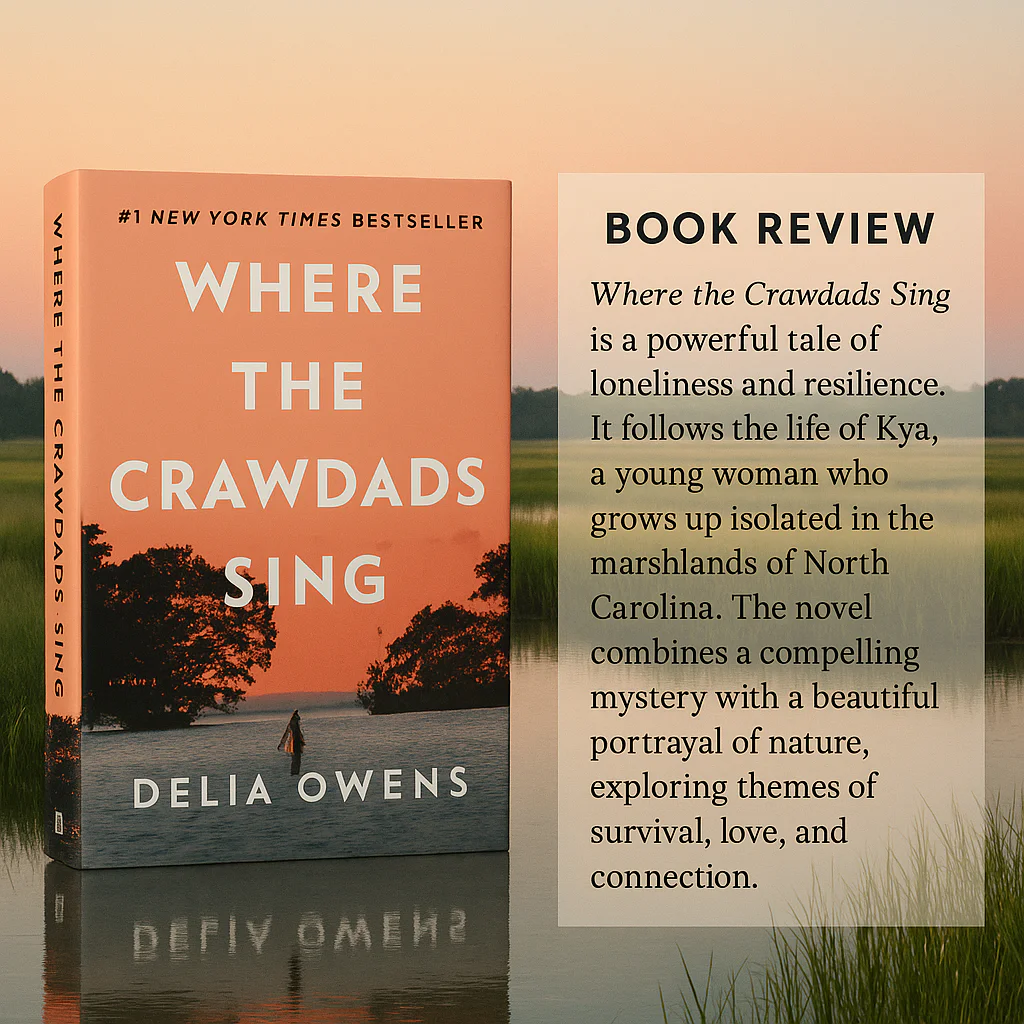
Our where the crawdads sing summary by-chapter guide covers all 57 chapters, tracks Kya’s life alongside Chase Andrews’s murder investigation, and explains the ending’s unsettling final clue. It’s a handy companion if the timelines have tangled together—or if you want to know exactly how a lonely child from the marsh becomes the center of a courtroom mystery.
The novel’s key to the mystery is how its two timelines gradually converge at the fire tower. Keep an eye on the evidence, but don’t mistake the town’s suspicion of Kya for proof: the courtroom verdict and the truth the epilogue hints at are not quite the same thing.
Key Takeaways
- The novel has 57 chapters and alternates between Kya’s coming-of-age story and the investigation into Chase’s death.
- Kya’s childhood abandonment shapes her adult relationships, especially her cautious connection with Tate and her troubled romance with Chase.
- Kya is acquitted at trial, but the final revelation strongly suggests what happened to Chase.
- The marsh is more than a setting: it represents Kya’s home, knowledge, refuge, and hard-won independence.
- The ending leaves a moral question behind: what should love do with a truth that could change everything?
Table of Contents
- ⚡️ Quick Tips and Facts
- 📚 Background: Where the Crawdads Sing and Its Setting
- About Delia Owens and the novel
- The North Carolina marsh and Barkley Cove
- Main characters and relationships
- 🧭 How to Read This Chapter-by-Chapter Summary
- Spoiler warning and chapter timeline
- The novel’s two timelines explained
- 📖 Where the Crawdads Sing Summary by Chapter
- 1. Chapter 1: “Ma”
- 2. Chapter 2: “Jodie”
- 3. Chapter 3: “Chase”
- 4. Chapter 4: “School”
- 5. Chapter 5: “The Fishing Season”
- 6. Chapter 6: “A Small Step”
- 7. Chapter 7: “The Fishing Season”
- 8. Chapter 8: “The Fishing Season”
- 9. Chapter 9: “The Fishing Season”
- 10. Chapter 10: “The Fishing Season”
- 11. Chapter 11: “The Fishing Season”
- 12. Chapter 12: “The Fishing Season”
- 13. Chapter 13: “The Fishing Season”
- 14. Chapter 14: “The Fishing Season”
- 15. Chapter 15: “The Fishing Season”
- 16. Chapter 16: “The Fishing Season”
- 17. Chapter 17: “The Fishing Season”
- 18. Chapter 18: “The Fishing Season”
- 19. Chapter 19: “The Fishing Season”
- 20. Chapter 20: “The Fishing Season”
- 21. Chapter 21: “The Fishing Season”
- 22. Chapter 22: “The Fishing Season”
- 23. Chapter 23: “The Fishing Season”
- 24. Chapter 24: “The Fishing Season”
- 25. Chapter 25: “The Fishing Season”
- 26. Chapter 26: “The Fishing Season”
- 27. Chapter 27: “The Fishing Season”
- 28. Chapter 28: “The Fishing Season”
- 29. Chapter 29: “The Fishing Season”
- 30. Chapter 30: “The Fishing Season”
- 31. Chapter 31: “The Fishing Season”
- 32. Chapter 32: “The Fishing Season”
- 33. Chapter 33: “The Fishing Season”
- 34. Chapter 34: “The Fishing Season”
- 35. Chapter 35: “The Fishing Season”
- 36. Chapter 36: “The Fishing Season”
- 37. Chapter 37: “The Fishing Season”
- 38. Chapter 38: “The Fishing Season”
- 39. Chapter 39: “The Fishing Season”
- 40. Chapter 40: “The Fishing Season”
- 41. Chapter 41: “The Fishing Season”
- 42. Chapter 42: “The Fishing Season”
- 43. Chapter 43: “The Fishing Season”
- 44. Chapter 44: “The Fishing Season”
- 45. Chapter 45: “The Fishing Season”
- 46. Chapter 46: “The Fishing Season”
- 47. Chapter 47: “The Fishing Season”
- 48. Chapter 48: “The Fishing Season”
- 49. Chapter 49: “The Fishing Season”
- 50. Chapter 50: “The Fishing Season”
- 51. Chapter 51: “The Fishing Season”
- 52. Chapter 52: “The Fishing Season”
- 53. Chapter 53: “The Fishing Season”
- 54. Chapter 54: “The Fishing Season”
- 55. Chapter 55: “The Fishing Season”
- 56. Chapter 56: “The Fishing Season”
- 57. Chapter 57: “The Fishing Season”
- 58. Complete plot recap: the story in one sweep
- 🔍 Major Plot Twists and the Ending Explained
- Who killed Chase Andrews?
- The courtroom verdict and final reveal
- What the ending means for Kya
- 🌿 Themes, Symbols, and Literary Devices
- Nature, survival, and the marsh as a character
- Loneliness, prejudice, and belonging
- Love, trust, and abandonment
- The fire tower, feathers, and other symbols
- 💬 Key Quotes and What They Mean
- 📝 Book Club Discussion Questions
- 🎬 Book vs. Movie: Key Differences
- 📚 What to Read After Where the Crawdads Sing
- ✅ Conclusion
- 🔗 Recommended Links
- ❓ FAQ
- How many chapters are in Where the Crawdads Sing?
- Is the chapter-by-chapter summary spoiler-free?
- What is Where the Crawdads Sing about?
- Who is the main character in the novel?
- What is the main message of the book?
- Is Where the Crawdads Sing based on a true story?
- What does the title mean?
- 📖 Reference Links
⚡️ Quick Tips and Facts
For readers who want the full 57-chapter plot breakdown, start with our Where the Crawdads Sing Book Summary by Chapter: All 57 📚. This guide adds character context, themes, the mystery’s evidence, and the ending’s moral knot.
Spoiler alert: This summary reveals the investigation, trial verdict, and final twist.
| Quick fact | Details |
|---|---|
| Author | Delia Owens |
| Published | 2018 by G. P. Putnam’s Sons, an imprint of Penguin Random House |
| Genre | Literary fiction, coming-of-age novel, and murder mystery |
| Main character | Kya Clark, known in Barkley Cove as the “Marsh Girl” |
| Setting | The marshes and coastal town of Barkley Cove, North Carolina |
| Chapter count | 57 chapters, preceded by a prologue in many editions |
| Story structure | Two timelines: Kya’s life from 1952 onward, and the investigation into Chase Andrews’s 1969 death |
| Central question | What happened to Chase—and can the town distinguish evidence from its prejudice against Kya? |
| Content notes | Domestic abuse, childhood abandonment, sexual violence, social prejudice, and imprisonment |
The novel is both a survival story and a courtroom mystery. If you come for the murder question, be prepared to stay for Kya’s fierce relationship with the marsh—and for a final revelation that makes the verdict feel less like answer than a locked door.
📚 Background: Where the Crawdads Sing and Its Setting

About Delia Owens and the novel
Delia Owens’s debut novel draws on her experience as a wildlife scientist and nature writer. Published by Penguin Random House, the book blends detailed natural observations with an invented coming-of-age story and a murder investigation.
That mix is part of its appeal—and a source of debate. Some readers love the lyrical marsh descriptions and slow-building emotional story; others come expecting a tightly paced police procedural and find that the investigation shares the stage with Kya’s life. In our view, that contrast is deliberate: the mystery asks who killed Chase, while the larger story asks what abandonment and prejudice do to a person.
For more fiction guides, browse our Book Summaries and Book Reviews.
The North Carolina marsh and Barkley Cove
The novel’s marsh is fictional, but its coastal setting evokes the tidal wetlands and estuaries of North Carolina. The North Carolina Department of Environmental Quality describes wetlands as ecosystems that support wildlife and help protect the coast. In Owens’s story, the marsh is also Kya’s home, classroom, livelihood, and refuge.
Barkley Cove’s social world is sharply divided. Kya’s shack sits outside the town’s accepted boundaries, and locals turn that distance into a label: “Marsh Girl.” The landscape shelters her, but it cannot shield her from gossip or the authorities’ suspicions.
Main characters and relationships
| Character | Role in Kya’s life | Why they matter |
|---|---|---|
| Kya Clark | The “Marsh Girl,” a naturalist and writer | Her childhood isolation shapes both her self-reliance and her fear of being left. |
| Tate Walker | Kya’s childhood friend and later partner | He gives Kya books and teaches her to read, but his departure reopens old wounds. |
| Chase Andrews | A popular local man and the murder victim | His relationship with Kya becomes central to both the romance plot and the investigation. |
| Jumpin’ and Mabel | A local couple who support Kya | They offer practical help and kindness without demanding that Kya become someone else. |
| Jodie Clark | Kya’s brother | His return reconnects Kya with her family history. |
| Pa and Ma | Kya’s parents | Their troubled family life and departures leave Kya to fend for herself. |
| Tom Milton | Kya’s defense lawyer | He challenges the prosecution’s case and helps the jury see the gap between suspicion and proof. |
| Sheriff Ed and Deputy Joe | Investigators | Their inquiry turns Kya’s outsider status into a focus of suspicion. |
🧭 How to Read This Chapter-by-Chapter Summary
Spoiler warning and chapter timeline
The novel has 57 chapters and moves between different years rather than telling Kya’s story in a straight line. The chapter titles and dates can vary in appearance across editions, so the guide below identifies chapters by their plot events and timeline rather than assigning invented titles.
That matters because some online summaries group chapters differently or use headings that are not chapter titles. We follow the novel’s chapter sequence and its two-track structure: Kya’s life in the marsh and the investigation and trial after Chase’s death.
The novel’s two timelines explained
| Timeline | What it follows | What it contributes |
|---|---|---|
| Kya’s life, beginning in 1952 | Her childhood, learning, relationships, and growing independence | Explains how abandonment shapes Kya and how she builds a life beyond the town’s judgment. |
| The investigation, beginning in 1969 | Chase’s body is found; police gather evidence and identify a suspect | Creates the central mystery and raises questions about proof, prejudice, and justice. |
| The trial, in 1970 | Witnesses and lawyers reconstruct events surrounding Chase’s death | Tests whether the prosecution can prove its case beyond reasonable doubt. |
| The final years | Kya and Tate’s life after the trial | Resolves the romance and reveals the story’s most unsettling secret. |
The timelines gradually converge at the fire tower. We know a body has been found, but the novel makes us wait to understand how Kya’s past, Chase’s death, and the town’s suspicions fit together.
📖 Where the Crawdads Sing Summary by Chapter
Chapter 1: Kya’s family begins to fracture
In 1952, six-year-old Kya lives with her parents and siblings in a remote shack near the marsh. Her father’s drinking and violence make home unpredictable. Her mother eventually leaves, followed by Kya’s siblings, each departure shrinking the child’s already fragile sense of safety.
Chapter 2: Kya is left with Pa
Kya remains with Pa, whose moods govern daily life. She learns to avoid provoking him and to manage small tasks on her own. Even at this young age, she notices how the marsh keeps going without asking anyone’s permission.
Chapter 3: Chase Andrews is found
In 1969, two boys discover Chase Andrews’s body below the fire tower. The body’s location and the absence of obvious signs of a struggle make the death puzzling. Sheriff Ed and Deputy Joe begin investigating whether Chase fell—or was pushed.
Chapter 4: School is not a refuge
Kya is taken to school, where the other children mock her as the “Marsh Girl.” Humiliated and overwhelmed, she runs back toward the marsh. The episode helps explain why she later avoids formal education, though it also leaves her without the reading skills she will need.
Chapter 5: Pa’s attention comes and goes
Pa alternates between neglect and brief efforts at connection. Kya hopes his kinder moments might last, but his affection never becomes dependable. The household’s pattern of emotional weather is as changeable as the tide.
Chapter 6: Kya learns to survive
With little adult guidance, Kya develops practical ways to keep herself fed and safe. She studies the world around her, learning from birds, water, plants, and seasons. The marsh becomes less a backdrop than a teacher that never gives a pop quiz.
Chapter 7: The case raises early questions
The investigation continues as the authorities look for physical evidence around the tower. The absence of clear tracks or a straightforward witness account complicates the case. Chase’s death is being treated as suspicious, but suspicion is not yet proof.
Chapter 8: The family sees Chase’s body
Chase’s family grieves and tries to make sense of his death. Investigators pursue medical and physical findings, but the early evidence does not hand them an easy explanation. The town’s questions begin to spread beyond the police station.
Chapter 9: A rare outing with Pa
Pa takes Kya out with him, giving her a glimpse of ordinary attention and a brief break from isolation. For Kya, small kindnesses matter enormously because they are so scarce. But the outing does not repair the instability of their home.
Chapter 10: Kya’s fear of being left deepens
Pa’s absence and unpredictability leave Kya trying to work out whether he will return. She learns to rely on routines and the marsh rather than on promises. The child’s survival skills grow, but so does her expectation that people disappear.
Chapter 11: Kya searches for connection
Kya seeks out Tate, whose presence offers the possibility of friendship. She is cautious, yet curious; she wants connection but has learned that closeness can be temporary. That push and pull will shape her adult relationships.
Chapter 12: The shack becomes Kya’s responsibility
Kya is increasingly left to manage alone. Food, shelter, and safety become immediate concerns rather than things she can assume adults will provide. Her childhood is disappearing by inches, not birthdays.
Chapter 13: Kya’s mother remains present through memory
By 1960, Kya is older and more aware of what she has lost. Her mother’s belongings and memories offer a link to the family life that once existed. Kya’s growth is visible, but the old abandonment still shapes her.
Chapter 14: Investigators examine how Chase died
The police consider whether Chase fell from the tower and examine the circumstances around the body. The physical scene offers clues but not certainty. The investigation starts to depend on reconstructing who had opportunity and when.
Chapter 15: Tate approaches Kya carefully
Tate begins building a relationship with Kya through shared interests and small gestures. He recognizes her knowledge of the marsh rather than treating her as a local curiosity. For Kya, being seen without being mocked is a startlingly generous experience.
Chapter 16: Tate teaches Kya to read
Tate brings Kya books and helps her learn to read. The lessons open a new world without replacing the one she already understands: Kya is an expert observer of nature long before she has access to printed pages. Their friendship deepens through patience and trust.
Chapter 17: Kya’s birthday offers a moment of belonging
Kya marks a birthday with Tate, finding joy in a connection that feels personal and safe. The celebration is modest, but its emotional importance is not. She is beginning to believe that someone might choose to stay.
Chapter 18: Jumpin’ warns Kya about social services
Jumpin’ tells Kya that people are asking questions about her and school attendance. Kya fears being removed from the only home she knows. The warning highlights a difficult tension: outside intervention might offer help, but to Kya it also threatens the fragile independence she has built.
Chapter 19: The investigation looks toward people close to Chase
Sheriff Ed and Deputy Joe continue interviews and examine Chase’s relationships. Kya’s name becomes relevant because of her connection to the victim, though the investigators still need more than a motive or rumor. The reader sees how a community’s assumptions can shape which questions get asked.
Chapter 20: Kya waits for Tate
Tate leaves for college, and Kya expects him to return. Days turn into a longer absence. Because Kya has already been abandoned by nearly everyone she loved, the silence carries more weight than Tate may understand.
Chapter 21: Tate’s absence reopens Kya’s old wound
Tate does not come back when Kya hopes he will. She struggles with grief and anger, interpreting his departure through the history of people leaving her. The marsh still provides comfort, but it cannot answer the question she most wants answered: why did he go?
Chapter 22: Chase enters Kya’s life
In 1965, Chase approaches Kya and begins courting her. He is confident and popular, a contrast to Tate’s quieter connection with her. Kya is drawn to his attention but remains alert to the possibility that affection may not be trustworthy.
Chapter 23: A picnic brings romance and unease
Kya and Chase share a picnic, and their relationship begins to take on romantic shape. Yet their different ways of seeing the marsh hint at a deeper mismatch: Kya experiences it as home, while Chase does not share her sense of belonging there. The attraction is real, but so are the warning signs.
Chapter 24: Kya lets herself hope
Kya becomes more emotionally invested in Chase. Her longing for love is tangled with her fear of abandonment, making each sign of affection feel especially powerful. She wants to believe this relationship is different from the losses that came before.
Chapter 25: Chase’s family enters the investigation
In 1969, investigators speak with Chase’s mother and gather information about his life and relationships. The questioning places Kya closer to the center of the case. The police still need a timeline and evidence, but the town already has a story about who the “Marsh Girl” is.
Chapter 26: Kya and Chase grow closer
The relationship continues, but differences in their values and expectations become clearer. Kya’s attachment is earnest; Chase’s behavior is less reassuring. Their romance is not a simple escape from loneliness—it exposes how vulnerable Kya remains to being misled.
Chapter 27: Kya’s hopes collide with Chase’s behavior
Kya prepares a meal to mark anniversary, hoping the occasion means something to Chase. His failure to treat it with similar care hurts her. This moment reflects a larger imbalance: Kya invests deeply, while Chase appears to take her devotion for granted.
Chapter 28: The investigators press on
Sheriff Ed and Deputy Joe continue tracking leads and comparing accounts. Their work takes place amid the town’s gossip, which can blur the line between a useful clue and an old prejudice. The case is moving forward, but not all the evidence points cleanly in one direction.
Chapter 29: Kya plans a birthday surprise
Kya prepares a romantic gesture for Chase’s birthday, hoping to strengthen their connection. Her care is sincere, but the relationship continues to offer uncertainty rather than security. The reader can feel the emotional balance tilting before Kya has all the facts.
Chapter 30: A discovery shakes Kya
Kya encounters information that devastates her and takes to the water, seeking distance from the pain. At the same time, her scientific writing begins to find a professional audience. The contrast is striking: her private life may be falling apart, but her knowledge and work are gaining recognition.
Chapter 31: Kya’s writing gives her independence
Kya secures a publishing opportunity for her nature observations and illustrations. The success brings income and validation on her own terms. It also shows how far she has come from the child who was mocked at school: she has built expertise without the approval of the town.
Chapter 32: Kya becomes a serious suspect
The investigation focuses more closely on Kya. Detectives question people who know her, including Tate and Jumpin’, and look for ways to connect her to the tower. The case now asks whether her relationship with Chase and her knowledge of the marsh add up to evidence—or merely make an easy story for the prosecution.
Chapter 33: A military visitor brings news
A young man in uniform visits Kya, interrupting her isolated routine. His arrival connects the personal story to the broader changes in the lives of people around her. Kya’s world is still remote, but it is not sealed off from time or consequence.
Chapter 34: Police search Kya’s home
Authorities legally search Kya’s shack for evidence. The invasion of her home intensifies her feeling of being watched and judged. To Kya, the shack is shelter and identity; to investigators, it is a place to examine for clues.
Chapter 35: The two timelines move closer
The novel returns to events leading up to Chase’s death, bringing Kya’s personal history and the investigation nearer to the same point. Earlier details gain new significance as readers reconsider what they know. The tower, once a location in the police reports, becomes the story’s central meeting place.
Chapter 36: Fibers strengthen the prosecution’s suspicion
Investigators learn that fibers associated with Kya’s hat appear to match fibers found near the crime scene. The result appears incriminating, but it does not independently establish when or how the fibers arrived there. The case gains a physical clue—and still has to explain what that clue proves.
Chapter 37: The police presence becomes oppressive
Repeated visits and questions make Kya feel pursued. Her solitude, once a survival strategy, now makes her conspicuous to authorities and townspeople. The novel sharpens a troubling question: is Kya being investigated because the evidence points to her, or because the town has long assumed she is dangerous?
Chapter 38: Kya is charged with murder
In 1970, Kya faces a first-degree murder charge. Tom Milton agrees to defend her and begins challenging the prosecution’s interpretation of the case. Kya is no longer merely the town’s outsider; she is an accused person whose freedom depends on how others read her life.
Chapter 39: A witness places Kya near the case
The trial examines testimony about Kya and Chase, including accounts that may support the prosecution’s theory. Witnesses bring their own memories and biases into the courtroom. As in the investigation, the question is not only what someone saw, but how confidently their recolection can be trusted.
Chapter 40: The prosecution builds its narrative
The prosecution presents a version of events that links Kya’s relationship with Chase, her knowledge of the area, and the evidence found by investigators. Tom Milton looks for gaps in that chain. A plausible story is not automatically a proven one, and the defense repeatedly presses that distinction.
Chapter 41: Kya recalls a frightening encounter
The narrative reveals the aftermath of an attempted sexual assault involving Chase. This changes how readers understand Kya’s fear and the danger within the relationship. It also complicates the central moral question: if Kya acted, what circumstances might have led her to believe she had to protect herself?
Chapter 42: Kya remains in jail
Kya is held without bail while the trial proceeds. Imprisonment strips away her freedom and places her in an unfamiliar, crowded environment. The contrast with the marsh is stark: outdoors, she could read signs and find her way; in jail, she must endure a system she cannot control.
Chapter 43: A trip to Greenville becomes part of the timeline
Kya receives an invitation to meet her editor in Greenville. The planned journey becomes important because the prosecution must establish when she travelled and whether she could have been near the tower. A trip that should signal professional success is now examined as possible evidence.
Chapter 44: Tom Milton supports Kya through the trial
Kya finds jail life distressing, while Tom continues visiting and preparing her defense. His work is practical, but his presence also gives her a rare experience: someone staying beside her when the stakes are high. The courtroom battle is about evidence; the emotional battle is about whether Kya can trust anyone.
Chapter 45: The coroner testifies
The coroner’s findings help the court assess how Chase died and whether his injuries fit a fall. The testimony provides a medical perspective, but it does not erase uncertainty about exactly what happened. The prosecution still must connect the circumstances of death to Kya.
Chapter 46: Kya considers her meeting with the editor
Before Chase’s death, Kya thinks about travelling to meet Robert Foster, her editor. Her plans suggest a future expanding beyond the marsh, though the case will later turn those ordinary preparations into a disputed timeline. The promise of a publishing career sits uneasily beside the danger closing in.
Chapter 47: The sheriff recounts finding Chase
Sheriff Ed describes the discovery of Chase’s body and the initial investigation. His account helps the jury reconstruct the scene. It also reminds readers that the case began with a body and a set of unanswered questions—not with proof of who caused the death.
Chapter 48: Kya travels to Greenville
Kya packs a suitcase and takes a bus to Greenville, leaving around October 28, 1969, and returning two days later. The trip becomes central to the prosecution’s timing argument. For Kya, it is connected to her writing; in court, it becomes a puzzle about opportunity and access.
Chapter 49: The prosecution examines Kya’s movements
Trial testimony addresses the bus journey and the possibility of Kya’s travel to and from Barkley Cove. The prosecution tries to place her within the relevant timeline. The defense challenges whether the available details establish that she could have committed the crime.
Chapter 50: Chase’s journal becomes evidence
A journal Kya gave Chase enters the trial discussion, revealing more about their relationship and how their private lives are being interpreted in public. The evidence may illuminate motive, but motive alone cannot prove an act. The courtroom is turning scraps of intimacy into arguments for guilt or innocence.
Chapter 51: A boat sighting adds another clue
A witness says he saw a boat heading toward the fire tower area. The sighting could be significant, but timing and identification matter: seeing a boat is not the same as identifying its passenger with certainty. The prosecution’s case grows through a series of pieces whose strength depends on how well they fit together.
Chapter 52: The defense challenges the evidence
Tom Milton calls defense witnesses and attacks weaknesses in the prosecution’s timeline and assumptions. He emphasizes uncertainty and the danger of treating Kya’s isolation as evidence of guilt. The defense does not need to prove an alternative story; it needs to show the jury that the prosecution has not proved its own.
Chapter 53: Closing arguments present two versions of the case
The lawyers offer competing accounts of the evidence. The prosecution frames the clues as a coherent path to guilt; the defense points to gaps, doubtful testimony, and a lack of decisive proof. The jury must decide whether a convincing narrative meets the legal standard.
Chapter 54: The jury reaches a verdict
Kya waits as the jury deliberates. The verdict is not guilty, and she is released. The trial settles the legal question, but not every question the novel has encouraged us to ask about Chase’s death.
Chapter 55: Jodie returns to Kya
After the trial, Jodie takes Kya home and reconnects with her. Their reunion brings a measure of family warmth to a life shaped by departures. Kya is acquitted, but the community’s judgment has already left its mark.
Chapter 56: Tate confronts loss and regret
Tate’s father dies, and Tate reflects on the time he spent away from Kya. He comes to understand how deeply his absence hurt her. His return offers the possibility of a lasting partnership, though neither love nor apology can undo the years of loneliness.
Chapter 57: Kya and Tate build a life—and Tate finds a secret
Kya and Tate live together and continue their work connected to the marsh. After Kya dies, Tate discovers poems signed “A.H.” that strongly suggest she was responsible for Chase’s death. He destroys them, choosing to keep her secret.
The ending therefore separates the courtroom verdict from the private truth Tate believes he has found. Kya is legally acquitted, yet the final evidence points toward her guilt. The book leaves readers with a question that is harder than “Who did it?”: What should loyalty do with a truth it cannot make right?
🔍 Major Plot Twists and the Ending Explained
Who killed Chase Andrews?
The trial ends with Kya’s acquittal, but the epilogue changes how readers interpret that verdict. Tate discovers poems signed “A.H.” that appear to reveal Kya killed Chase. He burns them, leaving no public proof and preserving the secret between them.
The most trustworthy distinction is this: the novel strongly implies Kya’s responsibility but does not show the killing directly as courtroom evidence. Readers are asked to infer the truth from the final poems and Tate’s response.
Some study guides summarize the final reveal as confirmation that Kya killed Chase; others describe it as a strong implication. We favor the more careful wording—the evidence strongly suggests it—because the novel leaves the act offstage and does not give readers a conventional confession.
The courtroom verdict and final reveal
Kya is found not guilty because the prosecution does not persuade the jury that it has proved the case beyond reasonable doubt. That legal outcome is compatible with the epilogue’s private revelation: a jury can acquit when evidence is insufficient, even if a later clue changes the reader’s view.
The trial depends on witness accounts, physical clues, and a disputed timeline. The final poems do not become evidence in court; Tate finds them after Kya’s death and destroys them. Legal innocence and factual guilt are not always the same question.
What the ending means for Kya
The ending is deliberately unsettling. Kya has survived abandonment, poverty, humiliation, and an abusive relationship. The final reveal may invite readers to see Chase’s death as an act of self-preservation, but it does not make the act morally simple or turn the murder mystery into a straightforward celebration of revenge.
It also leaves Tate with a choice: expose what he believes he has learned, or protect the woman he loves. His decision closes Kya’s secret from public view while opening a debate about justice, loyalty, and the limits of love.
🌿 Themes, Symbols, and Literary Devices
Nature, survival, and the marsh as a character
The marsh functions as Kya’s teacher and sanctuary. She learns to observe its rhythms and living things, developing expertise through attention and experience. The natural world is not sentimental, though; it offers both beauty and danger.
A video featured with this article takes a similar view of the marsh as Kya’s parent and refuge. Its memorable line—“Nature never judges or abandons her; it simply exists, wild and honest”—captures one interpretation of the book’s central contrast: human relationships fail Kya, while the marsh remains dependable.
Loneliness, prejudice, and belonging
Kya’s isolation is both physical and social. She lives outside town, but prejudice makes that distance feel like a verdict. People treat her as strange before they know her, and the nickname “Marsh Girl” reduces a full human life to a local label.
The novel asks readers to notice how community narratives work. Kya becomes a suspect partly because she is connected to Chase, but also because townspeople already regard her as an outsider. The story does not claim that prejudice alone explains the investigation; it shows how prejudice can shape which suspicions seem believable.
Love, trust, and abandonment
Kya wants connection but fears its cost. Tate’s departure and Chase’s behavior activate the same old wound in different ways. Her relationships reveal a difficult truth: self-reliance can protect someone from disappointment, but it can also make trust feel dangerous.
Jumpin’ and Mabel offer a counterpoint. Their kindness is steady and practical, showing that care does not have to be dramatic to matter.
The fire tower, feathers, and other symbols
| Symbol | Possible meaning in the novel |
|---|---|
| The marsh | Home, knowledge, identity, refuge, and the life Kya builds outside town’s approval |
| The fire tower | The site where the mystery converges and where competing versions of the truth meet |
| Feathers and natural specimens | Kya’s attention to detail, scientific curiosity, and private way of recording the world |
| Books and illustrations | Education, authorship, independence, and the recognition Kya earns through her own work |
| The poems signed “A.H.” | A concealed identity and the private truth Tate chooses not to reveal |
💬 Key Quotes and What They Mean
“The marsh was her mother.”
This image captures how the landscape provides Kya with shelter, nourishment, and instruction when her family cannot. It is poetic shorthand rather than a claim that nature replaces human care entirely.
“There are some who can live without wild things, and some who cannot.”
The line reflects Kya’s deep connection to the marsh and the natural world. For her, observation is not a hobby; it is a way of understanding herself and surviving.
“The trial and the truth aren’t quite the same thing.”
This phrase expresses the novel’s central distinction between a legal verdict and what may have happened in private. The jury acquits Kya, while the epilogue leads readers toward a different conclusion.
📝 Book Club Discussion Questions
- Does the novel present Kya’s self-reliance as empowering, tragic, or both?
- How do Barkley Cove’s judgments of Kya affect the investigation?
- Does Tate’s leaving make it harder to accept his eventual return?
- What does the marsh provide that the town does not?
- Does the final reveal change your feelings about Kya, or mainly change your understanding of the case?
- Was Tate right to destroy the poems? Why or why not?
- Can a jury reach a fair verdict when witness accounts and physical evidence remain uncertain?
- How does the book balance a coming-of-age story with a murder mystery?
- Does the novel explain Kya’s choices, excuse them, or leave readers to decide?
- Which relationship has the most lasting effect on Kya: her family, Tate, Chase, or Jumpin’ and Mabel?
🎬 Book vs. Movie: Key Differences
The film adaptation stars Daisy Edgar-Jones as Kya and adapts the novel’s marsh setting, romance, investigation, and courtroom plot for the screen. The book has more room for Kya’s interior life, her scientific observations, and the gradual development of the two timelines; a film must compress those elements into a shorter narrative.
| Element | Novel | Film adaptation |
|---|---|---|
| Kya’s inner life | Extensive access to memories, observations, and emotional shifts | Relies on performance, visuals, and dialogue |
| Nature writing | Detailed descriptions and natural-history passages | Presents the marsh visually and through selected scenes |
| Mystery structure | Alternates across many chapters and time periods | Condenses events and transitions for screen pacing |
| Character relationships | More room for gradual changes and history | Some developments are streamlined |
| Best for | Readers who enjoy atmosphere, reflection, and layered clues | Viewers who want a visual version of the central story |
For more adaptations, browse our Book-to-Film Adaptations collection.
📚 What to Read After Where the Crawdads Sing
If you liked the book’s mix of atmosphere, relationships, and mystery, try these next:
- The Great Alone by Kristin Hannah — A family drama set against a harsh landscape, with survival and isolation at its core.
- The Secret Life of Bees by Sue Monk Kidd — A coming-of-age novel about family secrets, belonging, and a young woman seeking a place to call home.
- The Nightingale by Kristin Hannah — A historical novel about sisters, resilience, and choices made under pressure.
- The Marsh King’s Daughter by Karen Dione — A thriller that, like Owens’s novel, uses a remote natural landscape and a complicated family past.
- The Bean Trees by Barbara Kingsolver — A character-driven story about independence, unexpected family, and finding community.
Our Book Reviews and Classic Literature sections have more reading ideas for your next book-club pick.