Support our educational content for free when you purchase through links on our site. Learn more
The Outsiders Characters: 10 Teens Worth Knowing 📚

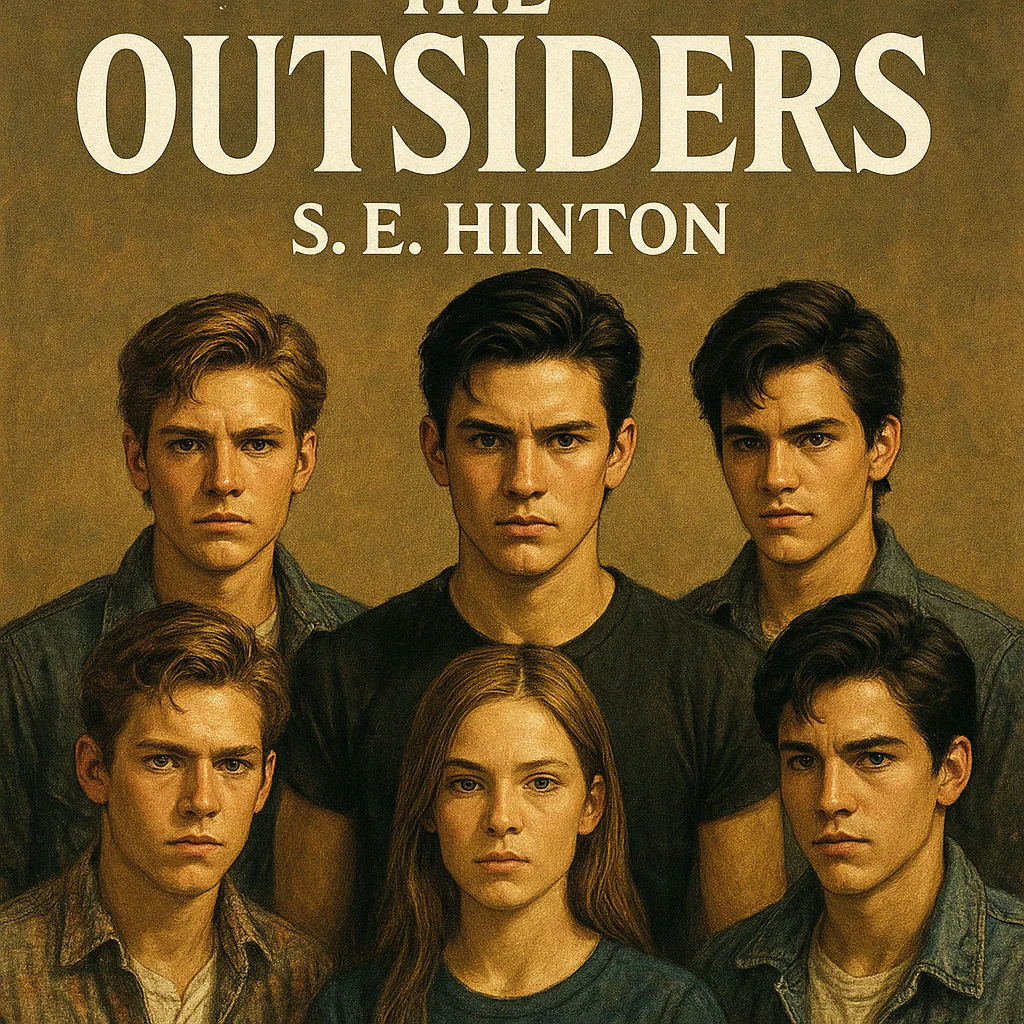

The Outsiders characters are what make S. E. Hinton’s novel more than a story about rival gangs: they’re complex teenagers wrestling with loyalty, grief, class, and the need to be understood. Ponyboy Curtis narrates the story, but Johnny Cade, Dally Winston, Cherry Valance, and the rest of the Greasers and Socs give its lasting emotional punch.
We love how quickly Hinton unsettles first impressions. Ponyboy is a Greaser who loves books and sunsets; Dally acts like he cares about nothing, until Johnny’s fate reveals just how much he does. Once you meet the characters beyond their labels, even a rumble feels less like a showdown and more like a tragedy in motion.
Key Takeaways
- Ponyboy is the narrator, but the story’s emotional core is shared by the Curtis brothers, Johnny, and Dally.
- The Greasers and Socs face different circumstances, yet characters on both sides challenge the stereotypes attached to their group.
- Family, friendship, grief, and violence shape the characters’ choices—and the consequences that follow.
- Johnny, Dally, Cherry, and Randy each reveal a different way to respond to fear, loyalty, and conflict.
- The novel offers more character insight than adaptations can easily show, especially through Ponyboy’s first-person narration.
Table of Contents
- ⚡️ Quick Tips and Facts: The Outsiders Characters
- 📚 S. E. Hinton’s Novel and Its World
- 👥 The Greasers: Main Characters and Their Stories
- 1. Ponyboy Curtis: The Thoughtful Narrator
- 2. Darel “Darry” Curtis: The Protective Older Brother
- 3. Sodapop Curtis: The Charming Middle Brother
- 4. Dallas “Dally” Winston: The Tough Outsider
- 5. Johnny Cade: The Gentle, Vulnerable Greaser
- 6. Keith “Two-Bit” Mathews: The Wisecracking Jokester
- 7. Steve Randle: Sodapop’s Best Friend
- 💎 The Socs: Main Characters and Their Stories
- 8. Cherry Valance: The Soc Who Ses Both Sides
- 9. Bob Sheldon: The Soc at the Center of the Conflict
- 10. Randy Adderson: The Soc Who Questions the Fight
- 🧩 Supporting Characters Who Shape the Story
- Marcia, Tim Shepard, and the Other Greasers
- The Curtis Brothers’ Parents and Family Life
- Teachers, Doctors, and Other Supporting Figures
- ⚖️ Greasers vs. Socs: Character Groups Compared
- 🤝 The Outsiders Character Relationships and Friendships
- 🌱 Character Development, Choices, and Turning Points
- 🔍 Major Themes Revealed Through the Characters
- 🎬 The Outsiders Characters in the Movie and Musical
- ❓ Frequently Asked Questions About The Outsiders Characters
- ✅ Conclusion
- 🔗 Recommended Links
- ❔ FAQ
- 📖 Reference Links
⚡️ Quick Tips and Facts: The Outsiders Characters
For the full plot behind these characters’ choices, start with our The Outsiders book summary. The character guide below focuses on who they are, how they change, and why a story about rival teen groups still feels so human.
| Quick fact | What to know |
|---|---|
| Author | S. E. Hinton |
| Narrator | Ponyboy Curtis, who tells the story in first person |
| Main groups | The Greasers and the Socs |
| Central conflict | Class division, violence, loyalty, and the desire to be understood |
| The Curtis brothers | Dary, Sodapop, and Ponyboy |
| Key friendships | Ponyboy and Johnny; Dally and Johnny; Ponyboy and Sodapop |
| Character lens | The labels matter—but the people underneath them matter more |
A small name check: The novel spells the eldest Curtis brother Darry (full name Darel), the gang’s joker Two-Bit Matthews, and the Soc Randy Adderson. You may see alternate spellings in fan pages and adaptations.
Our book-club shorthand: Ponyboy is the lens, Johnny is the tender heart, and Dally is the warning sign. But that neat little trio doesn’t explain everything. Why does the toughest greaser fall apart when the gentlest one dies? We’ll get there.
📚 S. E. Hinton’s Novel and Its World
S. E. Hinton’s The Outsiders follows teenagers in a divided community, where a person’s neighborhood, clothes, and money can shape how others treat them. The Greasers are working-class; the Socs (“Socials”) have more wealth and social status. Yet Hinton steadily complicates that simple split.
The novel was published in 1967, when Hinton was still a teenager. Her close observation of teenage life helps give the characters’ arguments and loyalties a lived-in feeling, rather than the polished distance of adults guessing what young people might say. For background on the novel and its place in literature, see the Encyclopaedia Britannica overview of S. E. Hinton and our classic literature coverage.
Why the characters matter more than the labels
The Greaser–Soc divide gives the plot its pressure, but Hinton’s characters keep poking holes in it:
- Ponyboy is a Greaser who loves books, films, and sunsets.
- Cherry is a Soc who recognizes that hardship is not exclusive to one group.
- Randy questions whether another rumble can change anything.
- Dally, who seems most committed toughness, is deeply attached to Johnny.
That contradiction is the point. A group identity can explain the pressure someone faces; it cannot tell you everything about who they are.
A note on names and adaptation details
The original novel is the best source for character details. Film and stage productions sometimes emphasize different traits or adjust minor details for performance. The official The Outsiders musical cast and creative page is useful for checking current production roles, but it is not a substitute for the novel when you want the original character descriptions.
👥 The Greasers: Main Characters and Their Stories
The Greasers are not a tidy team of identical leather jackets. They have different temperaments, family situations, and ideas about what survival requires. Their loyalty is real—but so are their arguments.
1. Ponyboy Curtis: The Thoughtful Narrator
Ponyboy is the novel’s fourteen-year-old narrator and youngest Curtis brother. His first-person account puts us close to his thoughts, including his uncertainty about whether he belongs in the tough world people expect him to inhabit.
He likes reading, going to the movies, and noticing beauty in ordinary things. That sensitivity isn’t a decorative trait: it shapes how he interprets violence and how he tries to make sense of the people around him.
What makes Ponyboy compelling? He can admire a sunset and still get swept into a fight. He is observant, but not all-knowing. Because we see events through him, the novel also asks us to consider how grief, fear, and age influence his understanding.
- Strength: Empathy and curiosity.
- Pressure point: He often feels misunderstood by Dary and underestimated by older Greasers.
- Key relationship: Johnny is his closest friend; Sodapop offers warmth, while Dary represents responsibility and rules.
- Turning point: After trauma and loss, Ponyboy begins to transform what happened into a story.
The famous image of “gold” in Johnny’s message to Ponyboy connects to the idea that innocence and beauty deserve protection. The line is meaningful not because Ponyboy stays untouched by hardship, but because he continues to look for goodness after it.
2. Darel “Darry” Curtis: The Protective Older Brother
The novel calls him Darry, short for Darel. After the Curtis parents die, he becomes guardian to Ponyboy and Sodapop. That means he is not simply an older brother: he is also the person trying to keep their household together.
Darry’s strictness can look like anger from Ponyboy’s point of view. But his hard edges come from a frighteningly practical worry: if the brothers cannot stay together, Ponyboy may be placed in a boys’ home. Dary has had to put aside his own opportunities to provide for the family.
- Strength: Discipline, intelligence, and fierce commitment.
- Pressure point: He carries adult responsibilities without the emotional distance of an adult.
- Key relationship: His love for Ponyboy is often expressed through rules, which Ponyboy initially reads as rejection.
- What to watch: The difference between Dary’s intention and Ponyboy’s interpretation.
Book-club verdict: Darry is not cold; he is overloaded. That distinction doesn’t make every harsh moment painless, but it makes his character more complicated than “strict big brother.”
3. Sodapop Curtis: The Charming Middle Brother
Sodapop is the middle Curtis brother, known for his good looks, easy charm, and affection for Ponyboy. He works at a gas station and left school before graduating. In the family, he often tries to soften the friction between Dary’s seriousness and Ponyboy’s sensitivity.
That mediator role has a cost. Soda wants his brothers to get along, but being the one who smooths everything over can leave his own feelings unattended. His relationship with Sandy also reveals that charm cannot magically make painful circumstances simple.
- Strength: Warmth and emotional generosity.
- Pressure point: He tries to carry other people’s tension so they won’t fight.
- Key relationship: His closeness with Ponyboy is one of the story’s most affectionate bonds.
- Story function: He shows that being the “easygoing” one doesn’t mean having no worries.
4. Dallas “Dally” Winston: The Tough Outsider
Dally is the most hardened Greaser, with a record of trouble and a habit of treating vulnerability as a liability. He acts as if caring is dangerous—and then Johnny proves that he cares more deeply than he wants anyone to know.
A fan character guide describes Dally as having a “dark, free-spirited streak” and emphasizes his loyalty to the gang (The Outsiders Fan Club character guide). That captures part of him, but the novel gives us a sharper contrast: Dally’s toughness helps him survive, yet it leaves him with few ways to process grief.
- Strength: Courage and resourcefulness in dangerous situations.
- Pressure point: He has trained himself to hide tenderness rather than live with it openly.
- Key relationship: Johnny is the person who gets past his armor.
- Turning point: Johnny’s death pushes Dally toward a final, reckless act.
Dally’s tragedy is not that he feels nothing. It’s that he has so little practice surviving what he feels.
5. Johnny Cade: The Gentle, Vulnerable Greaser
Johnny is quiet, anxious, and deeply affected by violence at home and outside it. The gang treats him like a younger brother, but his vulnerability should not be mistaken for weakness. When events turn dangerous, Johnny makes brave choices that change the course of the story.
His friendship with Ponyboy is built on trust and shared reflection. The two can talk about things that other members of the gang might shrug off, including the poem “Nothing Gold Can Stay,” by Robert Frost. The poem is available through the Poetry Foundation.
- Strength: Compassion and moral courage.
- Pressure point: He has little sense of safety or control.
- Key relationships: Ponyboy is his confidant; Dally is fiercely protective of him.
- Turning point: Johnny’s decision to protect others makes him a hero, but he pays a devastating price.
Some adaptations and summaries compress Johnny’s experience into a single heroic label. The novel gives more weight to the person behind that label: a boy who is frightened, thoughtful, loyal, and capable of extraordinary courage.
6. Keith “Two-Bit” Mathews: The Wisecracking Jokester
The novel spells his nickname Two-Bit and his surname Matthews. He is the gang’s joker, known for quick remarks, a switchblade, and a fondness for mischief. His humor often lowers the temperature when a scene gets tense—but it doesn’t mean he fails to understand how serious things are.
- Strength: Humor, loyalty, and social confidence.
- Pressure point: Jokes can deflect from difficult feelings.
- Key relationships: He looks out for Ponyboy and Johnny and belongs to the gang’s broader family-like circle.
- Story function: He gives the group levity without making its problems disappear.
One fan guide calls Two-Bit “the oldest in the group but youngest at heart,” a useful description of his playful energy (The Outsiders Fan Club). We’d add that his jokes are part of how he fits in—not proof that he’s shallow.
7. Steve Randle: Sodapop’s Best Friend
Steve is Sodapop’s best friend and works with him at the gas station. He knows cars and carries himself with confidence. He also sees Ponyboy as annoying kid tagging along, which gives the younger narrator a less-than-flattering view of him.
That friction matters. A character does not need a grand tragic arc to make a story feel like real life. Steve’s impatience helps show that the Greasers’ loyalty does not erase ordinary irritation, rivalries, and age gaps.
- Strength: Practical skills and confidence.
- Pressure point: He can be dismissive of Ponyboy.
- Key relationship: Sodapop is his closest friend.
- Story function: He broadens the gang beyond the central trio and gives the group its everyday texture.
💎 The Socs: Main Characters and Their Stories
The Socs have money and social advantages, but Hinton does not present them as a single personality type. Cherry and Randy, in particular, reveal different ways of living inside the same privileged group.
8. Cherry Valance: The Soc Who Ses Both Sides
Cherry is a Soc who meets Ponyboy and Johnny at the drive-in. Her conversations with Ponyboy challenge his assumptions about what wealthy teenagers experience—and, just as importantly, what they do not experience. She recognizes that “things are rough all over,” without pretending the groups face identical circumstances.
Cherry is not simply a bridge between the groups. She has her own boundaries and loyalties, including the painful fact that Bob is her boyfriend. She can sympathize with Ponyboy and still refuse to visit Johnny after Bob’s death.
- Strength: Self-awareness and willingness to listen.
- Pressure point: She is caught between personal sympathy and group loyalty.
- Key relationship: Her conversation with Ponyboy gives him a more complicated picture of Soc life.
- Story function: She helps undermine stereotypes without erasing real inequality.
9. Bob Sheldon: The Soc at the Center of the Conflict
Bob is a Soc whose violence toward Greasers fuels the central conflict. He is not shown only as a symbol of privilege; the novel also hints at a troubled relationship with his parents and a lack of boundaries. Context helps explain behavior, but it does not excuse the harm he causes.
Bob’s role is crucial because his death pushes Ponyboy, Johnny, and Dally into decisions that reshape their lives. He is a character whose actions have consequences far beyond the scene in which they occur.
- Story role: His aggression intensifies the conflict between the groups.
- Pressure point: Privilege and family dysfunction coexist in his story.
- Key relationship: His connection to Cherry complicates how she responds to events.
- What readers should hold together: Bob can be shaped by his circumstances and still be accountable for his choices.
10. Randy Adderson: The Soc Who Questions the Fight
The novel spells his surname Adderson. Randy is Bob’s friend and Cherry’s boyfriend’s social counterpart, but he begins to question what another rumble can accomplish. He sees the group conflict from inside the Soc circle and gradually recognizes its futility.
The shift is significant because Randy is not suddenly transformed into a Greaser ally. Instead, he becomes less willing to pretend that a fight will fix grief or division. His perspective gives the novel another route beyond the “us versus them” mentality.
- Strength: Honesty about his doubts.
- Pressure point: Loyalty to Bob and his social group complicates his choices.
- Key relationship: His conversations with Ponyboy open space for empathy across group lines.
- Story function: He gives voice to the question the rumble cannot answer: What happens after everyone stops fighting?
🧩 Supporting Characters Who Shape the Story
Not every important character needs equal page time. Some people shape the story through a single relationship, a decision, or the way they affect the main characters’ sense of safety.
Marcia, Tim Shepard, and the Other Greasers
Marcia is Cherry’s friend and gives the drive-in scenes more social texture. She is not just an accessory to Cherry’s character; her presence shows that the Soc group has its own friendships and everyday interactions.
Tim Shepard leads another Greaser gang. His presence widens the novel’s world beyond Ponyboy’s circle and shows that “Greasers” are not one perfectly unified family. Different groups have different leaders, reputations, and ways of handling conflict.
The Curtis gang’s friendships with these surrounding characters help establish a broader community—one where loyalty can be generous, but where group identity can also make violence feel inevitable.
The Curtis Brothers’ Parents and Family Life
The Curtis parents are absent from the present-day action because they have died. Their absence is nevertheless one of the strongest forces in the story: it places Dary in a parental role and makes the brothers’ ability to stay together feel precarious.
The family’s grief is not described as a neat backstory and then forgotten. It shapes how each brother behaves:
- Darry responds by working and taking control.
- Sodapop tries to keep the peace.
- Ponyboy struggles to understand whether strictness means rejection.
That triangle is one reason the domestic scenes feel so powerful. The Curtis brothers care for one another, but caring does not automatically make them good at communicating.
Teachers, Doctors, and Other Supporting Figures
Adults appear in the story largely through institutions and brief encounters: school, medical care, family authority, and law enforcement. Their limited presence reinforces how much the teenagers rely one another, but it also raises a difficult question: what happens when young people are left to manage problems that need adult protection?
This does not mean every adult in the novel is uncaring. Rather, the story keeps its focus on the teens’ immediate experience, where help can feel distant, inconsistent, or too late.
⚖️ Greasers vs. Socs: Character Groups Compared
The Greasers and Socs differ in class position and social treatment, but the novel resists turning those differences into a simple good-versus-bad chart.
| Lens | Greasers | Socs | What the novel complicates |
|---|---|---|---|
| Social position | Working-class and more exposed to economic pressure | Wealthier and more socially protected | Money affects opportunity, but it does not eliminate pain |
| Group image | Tough, rebellious, “greasy” | Polished, privileged, respectable | Public labels often hide private circumstances |
| Internal variety | Dary, Ponyboy, Dally, and Two-Bit respond differently to hardship | Cherry, Bob, and Randy respond differently to status and conflict | Neither group is emotionally or morally uniform |
| Relationship to violence | Often treated as suspicious or blamed | Can use privilege to avoid consequences | Violence crosses the divide, though consequences may not be equal |
| Main challenge | Being judged and having fewer options | Recognizing privilege and questioning group loyalty | Understanding another person does not erase structural differences |
Similarity is not the same as equality
Cherry’s “things are rough all over” idea invites empathy. It should not be used to flatten the difference between a teenager with fewer resources and one protected by wealth. The characters may share fear and grief while facing unequal risks and opportunities.
That distinction is why the novel’s best character conversations do more than say, “We’re all alike.” They ask readers to notice both the shared humanity and the unequal conditions.
🤝 The Outsiders Character Relationships and Friendships
Relationships are the story’s emotional engine. The rumbles create action; the friendships and family bonds explain what that action costs.
| Relationship | What it brings out |
|---|---|
| Ponyboy and Dary | Misread intentions, responsibility, and the ache of wanting approval |
| Ponyboy and Sodapop | Affection, trust, and emotional comfort |
| Ponyboy and Johnny | Shared sensitivity and the courage to act |
| Dally and Johnny | A hard exterior protecting a deep attachment |
| Cherry and Ponyboy | Conversation across class divisions |
| Randy and Ponyboy | Doubt about the value of repeating violence |
| Sodapop and Steve | Friendship grounded in work, routine, and shared history |
The Curtis brothers: love with crossed wires
Ponyboy believes Dary is too hard on him. Dary believes he is protecting the family. Sodapop sees the pain on both sides and tries to mediate. The brothers are not short on love; they are short on ways to express it without hurting one another.
Johnny and Dally: protection in opposite forms
Johnny is openly vulnerable, while Dally treats vulnerability as something to bury. Their connection reveals Dally’s tenderness more clearly than any speech about loyalty could. When that relationship is threatened, his tough persona stops functioning as armor.
Ponyboy and Cherry: empathy with boundaries
Their conversations show that people can connect across group lines without erasing the conflict between those groups. Cherry’s sympathy has limits, and Ponyboy has to learn that understanding another person does not mean they will make every choice he hopes for.
🌱 Character Development, Choices, and Turning Points
Character development in The Outsiders is not a tidy parade of people becoming wiser after one heartfelt conversation. Growth happens under pressure, through mistakes, and sometimes through loss.
Ponyboy: from observer to storyteller
Ponyboy begins as a teenager trying to make sense of his brothers, his gang, and the Socs. He already notices beauty and complexity, but experience forces him to examine what he thought he knew. Writing becomes a way to arrange painful events into something another person might understand.
This is where the opening and closing of the novel connect: Ponyboy’s narrative is not just a report of what happened. It is an attempt to reach someone who might otherwise be dismissed as another “outsider.”
Dary: love made visible
Darry’s change is less about becoming a different person than about Ponyboy beginning to understand what Dary has been carrying. Their relationship shifts when Ponyboy sees that his brother’s discipline comes from fear of losing the family, not from a lack of love.
Randy: questioning the cycle
Randy’s refusal to treat another rumble as a meaningful solution shows a form of courage that is easy to overlook. He cannot undo the past, but he can question whether repeating the same violence honors anyone.
Dally: the cost of refusing vulnerability
Dally’s story moves in the opposite direction. Rather than learning how to grieve, he loses the person who gives his loyalty a focus. His unraveling makes his toughness look less like strength and more like a strategy with no backup plan.
A step-by-step way to track character change
When comparing a character at the start and end of the novel, try this:
- Identify the belief they begin with. What do they assume about themselves or the other group?
- Find the pressure point. Which event challenges that belief?
- Notice their choice. Do they protect someone, withdraw, lash out, or reconsider?
- Look at the consequence. How does that decision change a relationship?
- Compare the ending. Has the character changed—or has the reader simply learned more about them?
This method is especially useful for Ponyboy and Randy, whose changes involve reflection, and Dally, whose loss shows the danger of having no safe way to process pain.
🔍 Major Themes Revealed Through the Characters
Class and social identity
The Greaser–Soc division influences how characters are treated and how they see themselves. The novel asks readers to look beyond stereotypes, while still showing that different social positions bring different pressures.
Family and found family
The Curtis brothers’ household is the story’s central family, but the gang also functions as a support network. That loyalty can be protective; it can also make dangerous group expectations harder to resist.
Violence and its aftermath
Fights are not isolated moments of action. They create fear, grief, guilt, and new conflict. The novel is less interested in treating violence as exciting than in showing how it follows people afterward.
Innocence, beauty, and growing up
Ponyboy and Johnny’s attention to sunsets and poetry offers a counterpoint to the roughness around them. These moments do not cancel the violence. They show what the characters are trying to hold on to in spite of it.
Empathy without easy answers
Cherry and Randy complicate the idea that group membership tells us who someone is. But empathy does not automatically solve inequality, erase accountability, or make every relationship possible. That tension keeps the novel’s moral questions alive.
🎬 The Outsiders Characters in the Movie and Musical
The book is the original source for these characters, while adaptations translate their inner lives into visual and performance choices. The 1983 film directed by Francis Ford Coppola is a notable adaptation; its cast includes C. Thomas Howell as Ponyboy, Ralph Machio as Johnny, Matt Dillon as Dally, and Patrick Swayze as Dary. The AFI Catalog entry for The Outsiders provides a film reference point, and our book-to-film adaptation coverage explores what changes when a story moves onscreen.
What changes across versions?
| Version | What it can emphasize | What readers may notice |
|---|---|---|
| Novel | Ponyboy’s narration and private thoughts | The most direct access to his interpretation of events |
| Film | Faces, performance, setting, and visual contrast | Some internal reflection must be conveyed through acting and images |
| Stage musical | Live performance, choreography, music, and ensemble storytelling | Character relationships can feel immediate and communal |
The stage production’s official cast and creative page lists performers and production roles. Casts can change, so consult that official page for current details rather than relying on an older roster.
A note on the character-introduction video
The first YouTube video featured in this article offers a brisk introduction to several central characters, including Ponyboy, Johnny, Dally, Dary, Sodapop, Cherry, and Two-Bit. Its strength is speed: it gives new readers a quick cast map. For nuance—especially around the reasons behind a character’s choices—the novel remains the better guide.
Should you read the book before watching?
If you want Ponyboy’s full interior perspective, read the novel first. If you have already seen an adaptation, the book adds context to relationships and choices that a film or stage production may have to compress. Readers looking for a broader overview can also browse our book summaries and book reviews.
❓ Frequently Asked Questions About The Outsiders Characters
Who are the main characters in The Outsiders?
The main characters include Ponyboy Curtis, his brothers Dary and Sodapop, Johnny Cade, Dallas “Dally” Winston, Two-Bit Matthews, and Steve Randle among the Greasers; and Cherry Valance, Bob Sheldon, and Randy Adderson among the Socs. Ponyboy is the narrator, so readers experience the story primarily through his perspective.
What are the differences between the Greasers and the Socs in The Outsiders?
The Greasers are working-class teenagers who face economic pressure and social stigma. The Socs are wealthier and have greater social protection. The groups are not identical in their circumstances, but members of both experience conflict, grief, and personal struggles. Characters such as Cherry and Randy reveal how individual people can question their group’s assumptions.
Who is the most important character in The Outsiders?
Ponyboy is the most central character because he narrates the novel and connects its major relationships and themes. But “most important” depends on what you mean: Johnny drives several key turning points, Dary anchors the Curtis family conflict, and Dally gives the novel one of its sharpest portrayals of grief and emotional armor.
How does Ponyboy change throughout The Outsiders?
Ponyboy begins as a sensitive teenager trying to understand his brothers and the social divide around him. As he experiences violence and loss, he becomes more aware that people cannot be reduced to their group labels. By turning events into a story, he begins to use his perspective not only to interpret his own life but also to invite others to understand it.
What happens to Johnny Cade in The Outsiders?
Johnny is badly injured while rescuing children from a burning church and later dies from his injuries. His courage affects Ponyboy and Dally in different ways: Ponyboy tries to make meaning of what happened, while Dally cannot cope with the loss.
Which characters in The Outsiders are based on real people?
S. E. Hinton has described the novel as drawing on observations of people and experiences, but readers should not assume that each character corresponds directly to one identifiable real person. The characters are fictional creations. Hinton’s youth and her attention to the social divisions around her helped inform the novel’s perspective; Britannica’s biography of Hinton provides background on the author.
How are the characters different in The Outsiders book and movie?
The novel gives readers Ponyboy’s thoughts directly, while a film relies on dialogue, visual detail, and performance to convey inner experience. As a result, some reflection and background may be shortened or presented differently in the movie. The basic character relationships remain recognizable, but the book offers more room for Ponyboy’s narration and interpretation.