Support our educational content for free when you purchase through links on our site. Learn more
Animal Farm Book Summary by Chapter: All 10 🐖

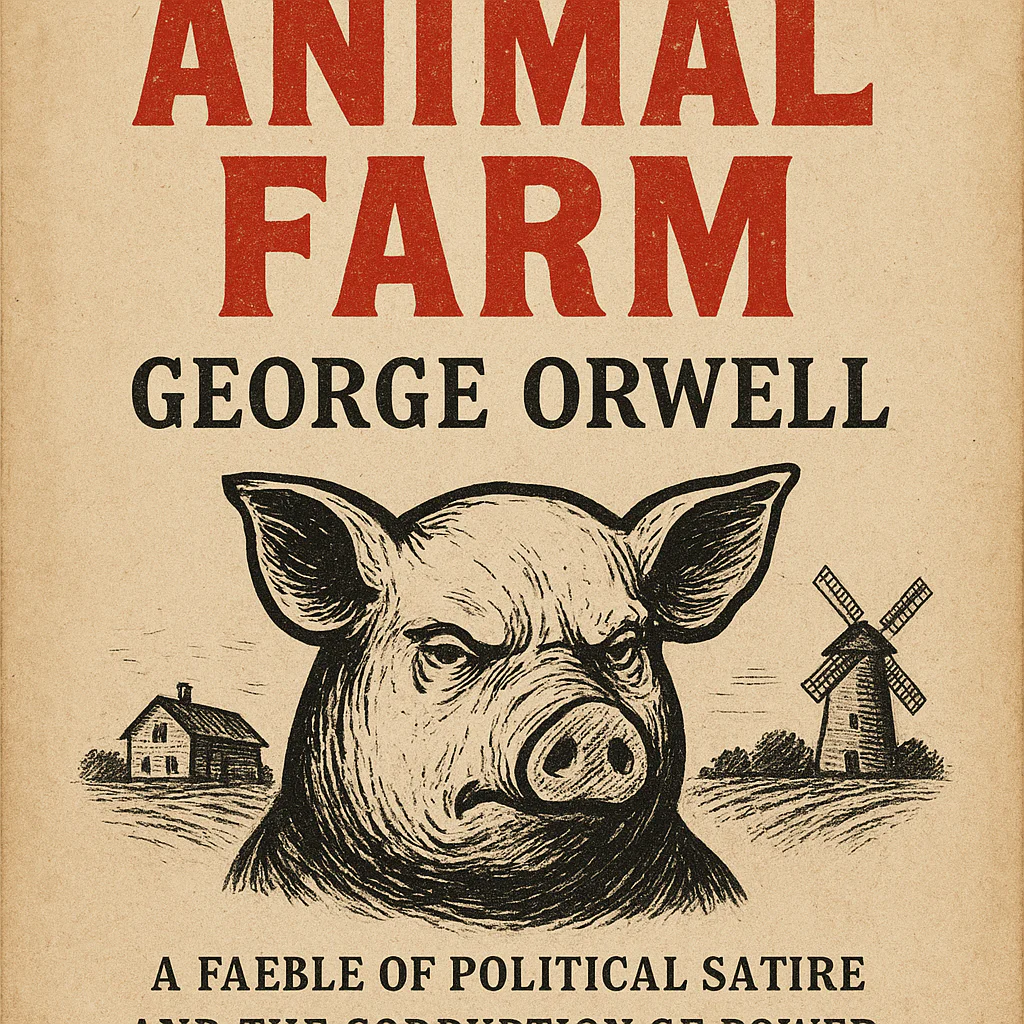

This Animal Farm book summary by chapter follows all 10 chapters, from Old Major’s vision of equality to the pigs’ chilling transformation into the rulers they once overthrew. The key to understanding Orwell’s fable is watching how power, propaganda, and rewritten rules gradually betray the rebellion.
The story moves quickly, but its small details do heavy lifting: the milk kept for the pigs, the commandments that mysteriously change, and Boxer’s unwavering faith that harder work will fix everything. We’ll trace those clues chapter by chapter and explain what they reveal about Orwell’s political satire.
Key Takeaways
- All 10 chapters are summarized in story order, with the turning points and consequences explained.
- Napoleon gains control through force and propaganda, driving out Snowball and silencing debate.
- The windmill and Seven Commandments show how leaders can use promises and altered rules to maintain power.
- Boxer’s fate exposes the cost of loyalty when a regime values workers only for what they can produce.
- The ending completes the allegory: the pigs become indistinguishable from the humans they replaced.
Table of Contents
- ⚡️ Quick Tips and Facts
- 📚 About Animal Farm: Orwell’s Political Fable
- Publication History and Historical Context
- What Is Animal Farm About?
- 🐖 Animal Farm Chapter-by-Chapter Summary
- Chapter 1 Summary: Old Major’s Vision
- Chapter 2 Summary: The Rebellion Begins
- Chapter 3 Summary: Life on Animal Farm
- Chapter 4 Summary: The Battle of the Cowshed
- Chapter 5 Summary: Snowball Is Driven Out
- Chapter 6 Summary: The Windmill and Human Trade
- Chapter 7 Summary: Hunger, Confessions, and Terror
- Chapter 8 Summary: Napoleon’s Power Grows
- Chapter 9 Summary: Boxer’s Fate
- Chapter 10 Summary: The Pigs Become Human
- 🔎 Animal Farm Characters and What They Represent
- Napoleon, Snowball, and Old Major
- Boxer, Clover, Benjamin, and the Other Animals
- Squealer and the Power of Propaganda
- 🎭 Animal Farm Themes and Literary Devices
- Power, Coruption, and Dictatorship
- Propaganda, Language, and Education
- Class, Inequality, and Exploitation
- Satire, Allegory, and Irony
- 🧩 Animal Farm Symbols and Their Meanings
- The Windmill
- The Seven Commandments
- The Farmhouse and the Whip
- 📜 The Russian Revolution Allegory Explained
- Animal Farm Characters and Historical Figures
- Key Events and Their Historical Parallels
- 💬 Important Animal Farm Quotes and Their Meaning
- 📝 Animal Farm Analysis for Students
- Chapter-by-Chapter Questions
- Essay Ideas and Discussion Prompts
- How to Write an Animal Farm Summary
- 🎬 Animal Farm Adaptations and Further Reading
- ✅ Conclusion
- 🔗 Recommended Links
- ❓ FAQ
- How many chapters are in Animal Farm?
- What is the main message of Animal Farm?
- Who is the villain in Animal Farm?
- What does the ending of Animal Farm mean?
- Is Animal Farm based on a true story?
- 📖 Reference Links
⚡️ Quick Tips and Facts
For the full companion overview, start with our Animal Farm book summary; here, we’ll follow Orwell’s story chapter by chapter and unpack the characters, history, and symbols along the way.
| Quick fact | Details |
|---|---|
| Author | George Orwell, the pen name of Eric Arthur Blair |
| First published | 1945 |
| Form | Political fable, allegory, and satire |
| Setting | A farm in England, first called Manor Farm and then Animal Farm |
| Number of chapters | 10 |
| Central conflict | Animals overthrow human rule, but the new leadership grows tyrannical |
| Key characters | Old Major, Napoleon, Snowball, Squealer, Boxer, Clover, and Benjamin |
| Famous refrain | “All animals are equal, but some animals are more equal than others.” |
Orwell’s novella is short enough to read in an afternoon and sharp enough to occupy a book club for an evening. The story’s plain style can make its political machinery look deceptively simple: a rebellion, a new government, a windmill, and a group of pigs who begin changing the rules. But the details matter. A small change in language, a missing food ration, or a familiar-looking van can reveal how the farm’s ideals are being dismantled.
A useful way to read it is to track three things:
- Who controls the rules?
- Who controls the story about what happened?
- Who benefits from the animals’ labor?
Keep those questions handy. By Chapter 10, they lead to an unsettling answer.
📚 About Animal Farm: Orwell’s Political Fable
Publication History and Historical Context
George Orwell published Animal Farm in 1945, near the end of the Second World War. The book uses a fictional farm to criticize the betrayal of revolutionary ideals and the rise of authoritarian rule. Orwell explained his political purpose in his essay “Why I Write,” hosted by the Orwell Foundation: he wanted political writing to become art, not to lose its political edge.
The novella draws particularly on the Russian Revolution and the Soviet Union under Joseph Stalin. That historical background clarifies many character parallels, but the fable is not a one-to-one history lesson. Orwell simplifies events and combines political figures and forces into vivid animal characters. The Encyclopaedia Britannica overview of Animal Farm also describes the book as an allegory of the Russian Revolution and Stalinist era.
| Book detail | Why it matters |
|---|---|
| The animals’ rebellion | Echoes a revolution against an unequal political order |
| The pigs’ leadership | Shows how a revolutionary elite can consolidate power |
| The changing commandments | Makes the rewriting of law and principle visible |
| Squealer’s speeches | Illustrate propaganda, manipulated memory, and political spin |
| The final card game | Condenses the book’s warning into a single, chilling image |
What Is Animal Farm About?
At Manor Farm, the animals rebel against their negligent owner, Mr. Jones, hoping to build a society in which they control their labor and share its rewards. At first, the rebellion appears successful. The farm is renamed, the animals make rules, and the harvest is gathered by its workers.
Then the pigs, who are the best readers and organizers, claim more authority. Napoleon eventually drives Snowball away and uses dogs, slogans, fear, and rewritten history to rule. The animals’ new society starts to resemble the old one, with one crucial twist: the new oppressors are animals, too.
The story is a strong choice for readers who enjoy classic literature, political satire, and books that invite close reading. For more chapter guides and plot explainers, browse our book summaries.
🐖 Animal Farm Chapter-by-Chapter Summary
The plot unfolds in ten chapters. The summary below follows the book’s sequence, while the analysis points out where a turning point begins to hide in plain sight.
| Chapter | Main event | Why it matters |
|---|---|---|
| 1 | Old Major delivers his speech | The animals receive a unifying vision |
| 2 | The Rebellion | Ideals become a new political order |
| 3 | The first harvest | The pigs start to separate themselves |
| 4 | The Battle of the Cowshed | The animals defend their revolution |
| 5 | Snowball’s expulsion | Napoleon replaces debate with force |
| 6 | The windmill is rebuilt | Labor and hardship are justified as progress |
| 7 | Confessions and executions | Terror becomes a tool of government |
| 8 | The windmill is destroyed | Napoleon’s propaganda recasts failure |
| 9 | Boxer is taken away | The working class pays for the pigs’ power |
| 10 | The pigs resemble humans | The revolution ends where it began |
Chapter 1 Summary: Old Major’s Vision
Old Major, an old and respected boar, calls the animals to a meeting in the barn after Mr. Jones has gone to bed. He describes their lives as short, hard, and controlled by humans, who take the products of their labor. He argues that humans are the source of the animals’ misery and predicts that rebellion will come.
Old Major urges the animals to resist becoming like their oppressors. They must not sleep in beds, wear clothes, drink alcohol, trade with humans, or tyrannize one another. His central principle is that all animals are comrades and equals.
The animals sing “Beasts of England,” a rousing song about a future without human rule. Jones hears the noise and fires his gun into the barn, breaking up the meeting.
Why this chapter matters: Old Major’s speech gives the animals a shared language and goal. It also sets up the central irony: he warns the animals not to copy human behavior, but those warnings will later be ignored by the very pigs who claim to preserve his teaching.
The LitCharts Chapter 1 guide notes how the meeting’s arrangement already hints at social distinctions: the pigs and dogs sit near the front, while many others gather behind them. The detail is small, but Orwell’s barn is already not quite an equal society.
Chapter 2 Summary: The Rebellion Begins
Old Major dies three nights after his speech. The pigs—especially Snowball, Napoleon, and Squealer—organize his ideas into a system they call Animalism. Not all animals understand it, but the pigs teach them its basic principles.
When Jones neglects to feed the animals, they break into the store-shed. Jones and his men respond with whips, but the hungry animals drive the humans from the farm. They rename Manor Farm Animal Farm and destroy objects associated with human control.
The animals paint the Seven Commandments on the barn wall. Among them are rules against wearing clothes, sleeping in beds, drinking alcohol, killing other animals, and imitating humans. The final commandment declares, “All animals are equal.”
The pigs take the milk and apples for themselves, claiming that they need special food because they do the farm’s “brainwork.” Squealer argues that if the pigs fail, Jones might return.
Why this chapter matters: The first unequal privilege appears almost immediately after the revolution. The pigs don’t present it as a privilege; they frame it as a necessary sacrifice for everyone else. That rhetorical move becomes a pattern.
Chapter 3 Summary: Life on Animal Farm
The animals bring in a successful harvest, working together without Jones’s supervision. Boxer becomes the farm’s most tireless worker. When a job goes wrong or seems difficult, he adopts the motto “I will work harder.”
The pigs supervise but do not perform physical labor. They organize committees and teach the animals to read and write, though most animals learn only a little. Snowball reduces the commandments to the slogan “Four legs good, two legs bad” so that less literate animals can remember the basic idea.
The pigs keep the milk and apples. Squealer insists they need this food for their health and says the animals would suffer if the pigs were unable to think.
Why this chapter matters: Education could help the animals question authority, but most remain unable to read the rules clearly. As the commandments become harder to check, the pigs gain room to interpret them for everyone else.
Chapter 4 Summary: The Battle of the Cowshed
News of the rebellion spreads to nearby farms. Mr. Jones, helped by other men, attempts to retake Animal Farm. Snowball has studied military tactics and leads the animals’ defense.
The animals ambush the humans, and the invaders retreat. The battle becomes known as the Battle of the Cowshed. Snowball and Boxer receive honors for their courage. Boxer is distressed when he thinks he has killed a human boy, but Snowball reassures him that the boy was already injured.
Why this chapter matters: The battle shows that the animals can cooperate to defend their freedom. It also establishes a public version of the past that Napoleon will later challenge, especially when Snowball becomes his political rival.
Chapter 5 Summary: Snowball Is Driven Out
Mollie, who likes sugar, ribbons, and human attention, resists the new order and eventually leaves the farm. Meanwhile, Napoleon and Snowball clash over how Animal Farm should be run.
Their sharpest disagreement concerns Snowball’s plan to build a windmill. Snowball argues that it could generate electricity and reduce the animals’ workload. Napoleon opposes the project. During a meeting, just as Snowball is winning support, Napoleon gives a signal. Nine large dogs chase Snowball off the farm.
Napoleon announces that the animals will build the windmill after all. The open meetings are abolished, and a committee of pigs will make decisions. Squealer later claims Snowball was a traitor and that Napoleon had supported the windmill plan from the beginning.
Why this chapter matters: Napoleon doesn’t win the argument. He makes sure there can be no more argument. The dogs turn political disagreement into a threat of physical violence, while Squealer supplies a story that makes Napoleon’s reversal sound consistent.
Chapter 6 Summary: The Windmill and Human Trade
The animals work harder than ever on the windmill, often laboring on Sundays. Napoleon says the farm needs the project, and the animals accept reduced rations and long hours as necessary sacrifices.
The pigs begin trading with humans through a solicitor, Mr. Whymper. Some animals remember the commandments against trade and money, but Squealer insists that they are mistaken. The pigs move into the farmhouse, and the animals later discover that they are sleeping in beds.
A violent storm destroys the partly built windmill. Napoleon blames Snowball, calling him a saboteur, and orders the animals to rebuild it.
Why this chapter matters: The windmill changes from Snowball’s proposal into Napoleon’s supposed plan, then becomes proof of Snowball’s alleged treachery. The animals keep working, but the explanation for why they must work keeps shifting.
Chapter 7 Summary: Hunger, Confessions, and Terror
Food grows scarce, and the animals struggle through winter. Napoleon hides the shortage from the human world, using Whymper to make the farm seem prosperous. He arranges to sell eggs, provoking the hens, who resist by laying their eggs where they will break. Napoleon responds by cutting their food and threatening punishment. Several hens die during the protest.
The animals are told that Snowball has been visiting the farm at night and causing trouble. At a meeting, several animals confess to crimes and are killed by Napoleon’s dogs. The executions horrify the surviving animals, who remember the commandment against killing other animals.
Later, Clover asks Muriel to read that commandment. It now says, “No animal shall kill any other animal without cause.”
Why this chapter matters: Fear replaces shared belief as the farm’s main source of unity. The altered commandment shows how the pigs turn a rule into an excuse: they do not need to abandon the language of justice if they can rewrite its meaning.
Chapter 8 Summary: Napoleon’s Power Grows
The animals discover that the commandment about drinking has changed to permit drinking “to excess.” Napoleon lives with increasing ceremony and rarely appears in public. Squealer continues to announce new successes, even as the animals face difficult work and food shortages.
The windmill is completed, but Napoleon sells timber to Frederick, a neighboring farmer. Frederick pays with forged banknotes, then attacks the farm with a group of men. The humans blow up the windmill. The animals fight back and drive them away, but many are wounded and the windmill is destroyed.
After the battle, the pigs discover whisky and celebrate. The animals later find that the rule about alcohol now forbids drinking “to excess.”
Why this chapter matters: When the windmill falls, Napoleon’s regime doesn’t admit that the project has failed. It turns the disaster into an enemy’s crime and a reason for further sacrifice. The animals must rebuild, yet again.
Chapter 9 Summary: Boxer’s Fate
The animals’ food rations are cut again, while the pigs and dogs receive special treatment. Boxer continues to work on the windmill despite his age and declining strength. He holds fast to two beliefs: “I will work harder” and “Napoleon is always right.”
When Boxer collapses, the pigs say they will send him to a veterinary hospital. Benjamin reads the writing on the van that comes to collect him: it belongs to a horse slaughter and glue boiler. Squealer later claims the van had been bought by a veterinarian, who had not yet changed its old sign. The animals accept this explanation, or are unable to challenge it.
The pigs use money from Boxer’s sale to buy whisky. Moses, the raven, returns with stories of Sugarcandy Mountain, a paradise where animals go after death.
Why this chapter matters: Boxer’s fate is the book’s most painful betrayal. He has given everything to the farm, yet the regime treats him as a resource to be sold when he can no longer work. His story makes the farm’s moral failure impossible to dress up as mere bad management.
Chapter 10 Summary: The Pigs Become Human
Years pass. Many of the animals who remember the Rebellion have died; the younger animals know it mostly through stories. The farm is larger and more prosperous, but most animals still work hard and receive little. The windmill now generates profit rather than freeing the animals from labor.
The pigs walk on two legs, carry whips, wear human clothes, and drink with neighboring farmers. The Seven Commandments are replaced by one: “All animals are equal, but some animals are more equal than others.”
Napoleon announces that the farm will return to its original name, Manor Farm. Looking through the farmhouse window, the animals watch a card game between pigs and humans. They can no longer tell the two groups apart.
Why this chapter matters: The ending completes the transformation Old Major warned against. The new ruling class has not merely copied the humans; it has erased the distinction between the two.
🔎 Animal Farm Characters and What They Represent
The characters work on two levels: they are animals with distinct personalities, and they stand for political roles or social groups. Orwell’s allegory is deliberately clear enough to follow but flexible enough to reward debate.
| Character | Role in the story | Common historical or political association |
|---|---|---|
| Old Major | Inspires the rebellion | Karl Marx and, in some respects, Vladimir Lenin |
| Napoleon | Seizes and keeps power | Joseph Stalin |
| Snowball | Revolutionary planner exiled by Napoleon | Leon Trotsky |
| Squealer | Defends the pigs’ policies | State propaganda and political spin |
| Boxer | Works loyally and unquestioningly | The exploited working class |
| Clover | Notices injustice but struggles to resist | Conscientious ordinary citizens |
| Benjamin | Skeptical and observant | Political cynicism or passive dissent |
| Mollie | Prefers comfort and status symbols | Those unwilling to give up privilege |
| Moses | Promises a paradise after death | Religion as consolation or social control |
| The dogs | Enforce Napoleon’s rule | Secret police and political intimidation |
| The sheep | Repeat slogans | A crowd shaped by simplified messaging |
These parallels are interpretations, not rigid labels. For instance, readers may debate whether Old Major represents Marx alone, Lenin, or the revolutionary tradition more broadly. The book’s purpose is not to assign every animal one perfect historical twin; it is to show how political roles and power relationships change.
Napoleon, Snowball, and Old Major
Old Major supplies the founding vision: a society free from human exploitation. He dies before the rebellion, so he never has to govern the farm or face the compromises his ideas would require. That gap between inspiration and implementation is crucial.
Snowball is energetic, persuasive, and interested in planning. He proposes the windmill, organizes committees, and helps lead the defense against Jones. But he is also part of the pig leadership that enjoys early privileges.
Napoleon is less interested in winning debates than in controlling the conditions under which debates happen. He trains the dogs, drives Snowball away, ends open meetings, and concentrates decision-making. The contrast is not simply “good Snowball versus evil Napoleon”: it is also argument and planning versus coercion and control.
Boxer, Clover, Benjamin, and the Other Animals
Boxer is physically powerful, generous, and deeply loyal. His slogans make him easy to admire—and easy to exploit. He believes that effort and obedience will solve problems created by the leadership.
Clover is more alert to contradictions. She senses that the farm’s principles have changed, but she cannot always read the commandments or identify exactly how they changed. Her uncertainty illustrates how poor access to education can make people vulnerable even when they recognize that something is wrong.
Benjamin can read and understands more than he says. His famous skepticism protects him from false hope, but it does not protect the other animals. His passivity raises an uncomfortable question: is seeing through propaganda enough if you never act on what you see?
Mollie, the cat, the hens, sheep, and other animals add different perspectives. Some prioritize comfort, some resist injustice, and others repeat the slogans they hear most often.
Squealer and the Power of Propaganda
Squealer is the pigs’ chief persuader. He answers objections with confident explanations, statistical claims, threats of Jones’s return, and attacks on the animals’ memories. His speeches rarely require the animals to see what is happening differently; they only need to doubt whether they saw it correctly.
The rule changes show his methods in miniature:
- A contradiction appears. The pigs begin sleeping in beds.
- The animals remember the rule. No animal is supposed to sleep in a bed.
- Squealer reframes the wording. The commandment forbids sheets, not beds.
- The animals accept uncertainty. Few can verify the text independently.
- The pigs keep the benefit. The rule now appears to support the leadership.
The film-summary perspective linked at the featured-video anchor likewise emphasizes the dogs’ role as Napoleon’s enforcers and Squealer’s role as the regime’s persuasive voice. That’s a useful quick recap; Orwell’s text gives us an extra layer to notice: the animals’ limited literacy makes propaganda work even when the evidence is written right on the barn wall.
🎭 Animal Farm Themes and Literary Devices
Power, Coruption, and Dictatorship
The animals overthrow one oppressive ruler, but they do not create safeguards to prevent a new elite from taking over. The pigs gain control of food, education, the dogs, political meetings, and the farm’s official history. Each advantage makes the next one easier to secure.
Orwell’s warning is not just that leaders can become corrupt. It is that power becomes hardest to challenge when leaders control both the rules and the explanation of the rules.
Propaganda, Language, and Education
The farm’s slogans are easy to remember, but they flatten complex issues into simple commands. “Four legs good, two legs bad” begins as a handy summary of Animalism. Later, the sheep repeat it at moments when discussion might become dangerous.
Language changes with power:
- Snowball becomes a traitor in the official story.
- Napoleon’s policies are presented as consistent, even when they reverse.
- The commandments acquire new words that excuse the pigs.
- The animals’ memories are treated as less reliable than Squealer’s claims.
Education matters because it gives characters different abilities to check those claims. The pigs can read, the sheep memorize, Boxer trusts slogans, and Benjamin understands but remains largely silent.
Class, Inequality, and Exploitation
The animals’ stated goal is a farm where those who work share its rewards. The pigs gradually separate themselves from physical labor and claim better food, better living conditions, and decision-making authority.
The hierarchy is visible in more than rations:
| What the pigs control | What the other animals experience |
|---|---|
| Written rules | Limited ability to read or verify them |
| Farm decisions | Little voice in policy |
| Official history | Uncertainty about what happened |
| Food distribution | Smaller rations and more labor |
| Security forces | Fear of punishment and violence |
Boxer makes the class theme personal. The farm praises his work while it benefits from him, then discards him when he becomes less productive.
Satire, Allegory, and Irony
An alegory uses a story and its characters to suggest broader political meanings. Satire uses humor, exaggeration, or ridicule to expose folly and injustice. Orwell combines both: the pigs’ use of human clothes and whips is comic at first, then grim.
The book’s irony grows through repetition. The farm’s leaders promise equality, then reserve privileges for themselves. They condemn human exploitation, then trade with humans. They overthrow Manor Farm, then restore its name. The story’s final image is powerful because the animals cannot tell whether the faces in the window belong to pigs or people.
🧩 Animal Farm Symbols and Their Meanings
| Symbol | Meaning in the story |
|---|---|
| The windmill | Promised progress, collective labor, and the way leaders use future benefits to justify present hardship |
| The Seven Commandments | The revolution’s written ideals—and the vulnerability of ideals when authorities control the text |
| The farmhouse | Privilege, separation from ordinary labor, and the pigs’ gradual adoption of human status |
| The dogs | Political force used to silence opposition |
| “Beasts of England” | Shared hope and revolutionary identity |
| Whips | Open domination, eventually adopted by the pigs themselves |
| Sugarcandy Mountain | The promise of an afterlife that can comfort animals without changing their lives |
The Windmill
The windmill is first Snowball’s vision of a more comfortable future. Napoleon rejects the idea, then claims it as his own after Snowball’s expulsion. Building it demands tremendous labor, and its destruction gives the regime an enemy to blame.
The symbol is deliberately double-edged: the windmill represents hope and progress, but it also becomes a political instrument. The animals are repeatedly told to sacrifice now for a future that never arrives in the way they were promised.
The Seven Commandments
The commandments begin as the written foundation of Animalism. Their changes chart the pigs’ rise from revolutionary leaders to a ruling class that rewrites the rules to suit itself.
Because the animals cannot all read well, the commandments do not function as reliable protections. Their wording can be revised, and the animals’ memories can be challenged. The final commandment removes the original promise of equality in everything but wording: the animals remain “equal,” but the rulers define what equality means.
The Farmhouse and the Whip
At the beginning, the farmhouse represents the human privilege the animals resent. The pigs first declare it a museum, then move into it. The whips work similarly: they are initially symbols of Jones’s cruelty, then become tools carried by the pigs.
The progression is blunt by design. The objects do not change; the owners do.
📜 The Russian Revolution Allegory Explained
The book’s historical parallels help explain its political satire, but it is best read as a literary allegory, not as a complete account of Soviet history. Individual animals can stand for people, institutions, or broader social forces depending on the moment.
Animal Farm Characters and Historical Figures
| Character or group | Commonly suggested connection | Interpretive caution |
|---|---|---|
| Old Major | Marxist revolutionary theory; often also associated with Lenin | He combines inspiration and ideology rather than mapping neatly to one person |
| Napoleon | Stalin | The comparison is strong, but Napoleon also represents authoritarian rule more broadly |
| Snowball | Trotsky | The expulsion and later demonization recall Trotsky’s political fate |
| Squealer | State propaganda apparatus | He is a character as well as a symbol of controlled messaging |
| Boxer | Working class | His personal loyalty and fate give the allegory human emotional weight |
| The dogs | Political police | Their function matters more than a single historical organization |
| Mr. Jones | The old regime | His neglect helps trigger rebellion but does not make the new order just |
These associations are widely taught, but they are not the only useful reading. The Orwell Foundation’s author materials and the Britannica overview provide reliable background for readers who want to distinguish the novella’s fictional design from its historical context.
Key Events and Their Historical Parallels
| Novel event | Broad historical parallel |
|---|---|
| Rebellion against Jones | Revolution against the old political order |
| Pigs take leadership | Revolutionary party gains authority |
| Napoleon expels Snowball | Political rival is forced into exile |
| Dogs enforce Napoleon’s rule | Coercive state power silences opposition |
| Animals confess and are executed | Purges and public confessions |
| Commandments are changed | Political principles are revised to justify current policy |
| Pigs trade with humans | Revolutionary leaders adopt practices they once condemned |
The comparison works best when we resist treating every event as a perfect match. Orwell compresses history to make the story readable and the pattern visible: a revolution promises equality, a leadership group captures the institutions, and the public loses the ability to hold that group accountable.
💬 Important Animal Farm Quotes and Their Meaning
| Quote | Who or what it reveals |
|---|---|
| “All animals are equal.” | The original promise of the rebellion |
| “Four legs good, two legs bad.” | A complicated political idea reduced to a chant |
| “I will work harder.” | Boxer’s faith in labor and self-sacrifice |
| “Napoleon is always right.” | Boxer’s trust in authority replacing judgment |
| “All animals are equal, but some animals are more equal than others.” | The final contradiction at the heart of the regime |
These short lines are memorable because they change meaning as the plot advances. The equality slogan first sounds like a genuine principle; by the end, its contradiction is the point. The familiar chapter-by-chapter summary at UKEssays also tracks the commandments’ revisions as the pigs’ power expands. The exact importance of any quote depends on the scene around it, so read the words in context rather than treating them as detachable slogans.
📝 Animal Farm Analysis for Students
Chapter-by-Chapter Questions
Use these questions to move beyond plot recall:
- Chapter 1: How does Old Major persuade the animals, and what does his absolute division between humans and animals leave out?
- Chapter 2: Why do the pigs take the milk and apples? How does Squealer justify the decision?
- Chapter 3: What does the animals’ uneven literacy allow the pigs to do?
- Chapter 4: What does Snowball’s role in the battle suggest about his leadership?
- Chapter 5: At what point does Napoleon’s control stop being political competition and become force?
- Chapter 6: How does the windmill’s meaning change after Snowball’s expulsion?
- Chapter 7: Why do the executions frighten the animals even though the pigs say they have protected the farm?
- Chapter 8: What is the effect of the windmill’s destruction on Napoleon’s authority?
- Chapter 9: Why is Boxer’s fate more than an individual tragedy?
- Chapter 10: What does the final scene show that a direct explanation might not?
Essay Ideas and Discussion Prompts
- How does Orwell show the relationship between political power and language?
- Is Boxer responsible for his own fate, or does the farm’s leadership bear full responsibility?
- What does the windmill represent at different points in the story?
- Why do the animals fail to resist the pigs as the commandments change?
- Does Benjamin’s skepticism make him wise, complicit, or both?
- How does Orwell use comedy to make the novella’s darker events more disturbing?
- Is the final scene a warning about specific historical events or a broader pattern of political power?
A strong essay makes a claim, then follows the story’s evidence. Instead of writing “Napoleon is bad,” for example, explain how he gains power: he controls force, narows political debate, and uses Squealer to reshape the animals’ understanding of events.
How to Write an Animal Farm Summary
Build a concise summary in four steps:
- State the setup: The animals overthrow Jones to create a farm of their own.
- Identify the turning point: Napoleon drives Snowball away and ends open debate.
- Trace the pattern: The pigs take privileges, change the rules, and use propaganda and force.
- Explain the ending: The pigs become indistinguishable from the humans they replaced.
Keep interpretation separate from plot. “The pigs move into the farmhouse” is plot; “the farmhouse symbolizes growing privilege” is analysis. Strong school responses include both, but they do different jobs.
🎬 Animal Farm Adaptations and Further Reading
Adaptations can make the story easier to revisit, but they may change its emphasis or ending. Orwell’s prose is notably plain and controlled, so it is worth reading the text itself rather than relying only on a film version.
For wider reading, explore our sections on book-to-film adaptations, classic literature, and book reviews. The Orwell Foundation is a useful source for Orwell’s life and writing, while Britannica’s entry on the novella offers concise historical context.
If you’re comparing summaries, treat a chapter guide as a map, not a substitute for the road. Some guides emphasize historical parallels; others prioritize plot events or literary devices. For instance, UKEssays’ chapter-by-chapter summary provides a compact plot sequence, while LitCharts’ Chapter 1 guide draws attention to the meeting’s social arrangement and symbolism. A blocked CliffsNotes page is not evidence about the book itself; when access restrictions prevent verification, rely on the text and sources that provide accessible chapter analysis.
For readers who like to compare a summary with the book in hand, browse available editions through Amazon’s Animal Farm search results or look for a library copy through WorldCat.