Support our educational content for free when you purchase through links on our site. Learn more
📘 *Wonder* Book Summary: SparkNotes-Style Guide

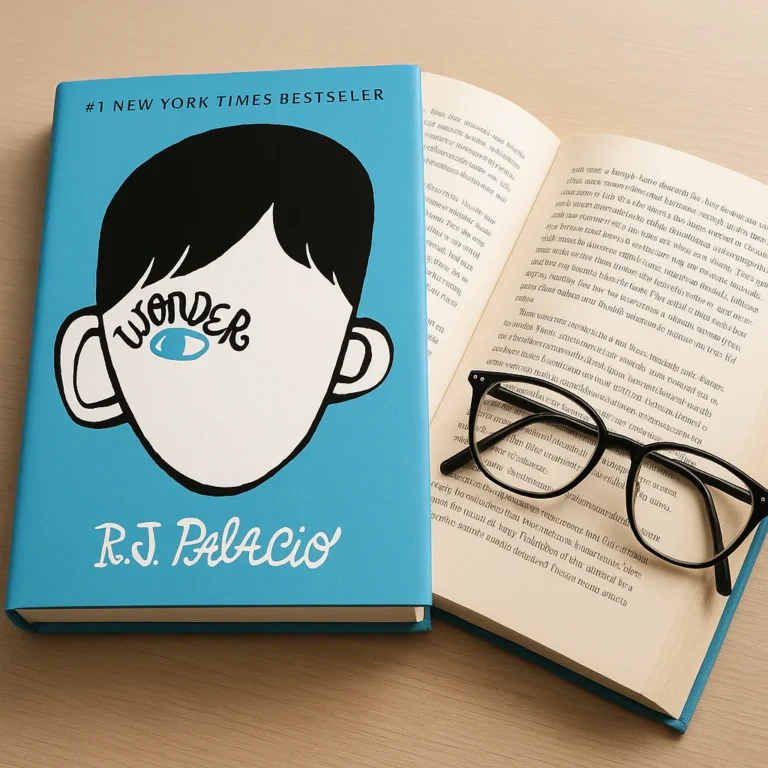
This Wonder book summary SparkNotes-style guide gives you the plot, characters, themes, and ending of R.J. Palacio’s novel in one place. The short version: Augie Pullman’s first year at school shows how friendship, family, and everyday choices can turn a lonely start into a real sense of belonging.
Auggie’s story is moving, but the novel is more than a lesson about being kind. Its shifting narrators reveal how the same school year feels to Augie, his sister Via, and the classmates learning to see beyond first impressions.
Key Takeaways
- Auggie starts fifth grade at Beecher Prep after years of homeschooling and faces both bullying and new friendships.
- The story uses multiple narrators, giving Via, Jack, Summer, and others space to share their perspectives.
- Major themes include kindness, belonging, peer pressure, family, and identity.
- The ending is hopeful: Augie is honored by his school and increasingly recognized for who he is.
- This guide is a useful study companion, but reading the novel offers the full voice, humor, and detail behind its message.
Table of Contents
- ⚡️ Quick Tips and Facts About Wonder
- 📚 Background: R.J. Palacio and the Story Behind Wonder
- 📝 Wonder Book Summary: The Full Story, Spoilers Included
- August Pullman’s First Year at Beecher Prep
- The Story Through Via, Summer, Jack, and the Other Narrators
- The Nature Retreat and the Final School Celebration
- 👥 Wonder Characters: August Pullman, Via, Jack Will, and More
- 🏫 Setting: Beecher Prep and the Pullman Family Home
- 💡 Major Themes in Wonder: Kindness, Belonging, and Appearance
- Choosing Kindness and Showing Empathy
- Friendship, Loyalty, and Peer Pressure
- Identity, Family, and Belonging
- Bulying, Courage, and Personal Growth
- 🔍 Wonder Analysis: Point of View, Structure, and Literary Devices
- 📖 The “Choose Kind” Message and the Book’s Precepts
- 💬 Memorable Wonder Quotes and What They Mean
- 🎓 Wonder Study Guide: Discussion Questions and Essay Ideas
- Book Club and Classroom Discussion Questions
- Essay Topics and Short-Answer Prompts
- 🔄 Wonder vs. SparkNotes: What This Summary Covers
- 🎬 Wonder Book vs. Movie: Key Differences
- 📚 What to Read After Wonder: Related Books and Series
- ✅ Is Wonder Worth Reading? Who Will Enjoy It
- 🏁 Conclusion
- 🔗 Recommended Links
- ❓ FAQ About Wonder
- 📑 Reference Links
⚡️ Quick Tips and Facts About Wonder
If you’re looking for a clear Wonder book summary, here’s the quick version: R.J. Palacio’s middle-grade novel follows August “Auggie” Pullman through his first year at school, where friendship, bullying, family life, and the choice to treat people kindly all matter far more than fitting in.
At a glance
| Fact | Details |
|---|---|
| Author | R.J. Palacio, the pen name of Raquel Jaramillo |
| First published | 2012 by Alfred A. Knopf Books for Young Readers |
| Genre | Middle-grade contemporary fiction |
| Main character | August “Auggie” Pullman, a 10-year-old boy with a facial difference |
| Main setting | Beecher Prep and the Pullman family home in New York City |
| Story structure | Several first-person narrators share different sides of the story |
| Central ideas | Kindness, empathy, belonging, friendship, bullying, and family |
| Adaptation | A 2017 film starring Jacob Tremblay, Julia Roberts, and Owen Wilson |
Palacio has said the story grew from an uncomfortable real-life encounter that prompted her to think about how adults can teach empathy. The author’s background and the novel’s publication are described by R.J. Palacio’s official site and Penguin Random House.
The short answer
- Auggie begins fifth grade at Beecher Prep after being homescholed for years.
- He faces stares, exclusion, and bullying, but also forms real friendships with Summer Dawson and Jack Will.
- The story changes narrators, showing how Augie’s school year affects his sister Via and classmates, too.
- A school retreat becomes a turning point when students who once kept their distance stand up for him.
- The ending is hopeful: Augie is recognized for his courage and character, not simply for the way he looks.
A useful reading tip: The book’s message isn’t “be nice because a person has had a hard life.” It’s closer to treat people as full human beings, and choose kindness because it’s the right thing to do. That distinction gives the story more heart than a simple anti-bulying lesson.
📚 Background: R.J. Palacio and the Story Behind Wonder
R.J. Palacio began her career as an art director and book jacket designer. She has explained that an encounter involving her young son and a child with a facial difference stayed with her. She wished she had handled the moment differently and used that reflection as a starting point for a story about empathy. In interviews and on her official author site, Palacio has discussed how the seed of Wonder grew into Augie’s story.
The novel was published in 2012 and became widely read in homes, schools, and book clubs. Its reach includes more than the original novel: related works include Auggie & Me, 365 Days of Wonder, and the picture book We’re All Wonders. See the publisher’s book and series information.
What kind of book is it?
Wonder is a middle-grade novel, but its questions aren’t confined to the middle-school years. It asks what children owe one another, how families divide attention, and whether a person can be kind while still making a hurtful mistake.
| Element | What readers can expect |
|---|---|
| Tone | Warm and often funny, with emotionally difficult moments |
| Narration | First-person accounts from several characters |
| Pacing | Episodic, following school events and family milestones |
| Content | Bulying, social exclusion, illness, grief, and disability-related staring |
| Best suited to | Readers who enjoy character-led stories and classroom discussion |
| Potential drawback | Some readers may find the lesson-driven passages overly neat or sentimental |
The different narrators are not decorative extras. They answer a question the book keeps nudging us to consider: What changes when we stop treating one person’s experience as the whole story?
A note on disability representation
Readers’ responses to Augie’s portrayal are not all the same. Some appreciate that the novel gives young readers a way to discuss facial difference, staring, exclusion, and everyday courtesy. Others have questioned whether Augie sometimes functions as a catalyst for other characters’ moral growth, rather than receiving as much interior complexity as they would like.
Those perspectives can coexist. Wonder has encouraged empathy for many readers, while still inviting discussion about who gets to tell disability stories and whose experiences are centered. For broader guidance on respectful language and disability inclusion, see the National Center on Disability and Journalism’s style guide.
📝 Wonder Book Summary: The Full Story, Spoilers Included
Spoiler alert: This section reveals the major events and ending.
August Pullman, known as Augie, is a funny, science-loving kid who has undergone many surgeries because of a rare genetic condition affecting his facial development. He has been homescholed by his mother, Isabel, but his parents decide that fifth grade is the right time for him to attend Beecher Prep.
Auggie knows school will bring challenges. He cannot control people’s first reactions to his face, and he would rather not be stared at. Still, he wants the ordinary things kids want: friends, jokes, lunch-table company, and a chance to be known for more than his appearance.
August Pullman’s First Year at Beecher Prep
Before school begins, principal Mr. Tushman arranges for three students—Jack Will, Julian, and Charlotte—to show Augie around. The introductions quickly reveal different attitudes. Jack is relatively welcoming, Charlotte is polite, and Julian makes comments that show he is already judging Augie by his appearance.
The first days are hard. Some students avoid Augie or react to him with visible discomfort. A rumor turns ordinary contact into a cruel game, and Julian’s behavior helps make school feel like a place where Augie is being watched rather than welcomed.
But there are bright spots. Summer Dawson chooses to sit with Augie at lunch, without making a show of it. Her decision matters precisely because it is so ordinary: she treats him like a kid she wants to know.
Jack becomes Augie’s friend, too, and their shared humor gives the friendship an easy, believable feel. Then Halloween brings the book’s first major emotional rupture. Augie, in costume, overhears Jack telling Julian that he would kill himself if he looked like Augie. Jack is trying to impress the other boys, but Augie hears the words, not the excuse behind them. He withdraws from Jack.
Summer senses there is more to the story than Augie’s silence suggests. She gives Jack a cryptic clue—“Bleding Scream”—that helps him understand why Augie is hurt. Jack regrets what he said, and his later willingness to stand up to Julian becomes part of how he tries to repair the damage. The friendship returns, but the book doesn’t pretend that a sincere apology makes hurt vanish instantly.
The Story Through Via, Summer, Jack, and the Other Narrators
The novel shifts away from Augie to show what the people around him are carrying.
Via, Augie’s older sister, loves him fiercely. She also feels that her own concerns often shrink beside the needs of a younger brother whose medical history has shaped family life. This isn’t presented as a lack of love; it’s the complicated truth of being a sibling in a family where one child needs intensive care and attention.
At high school, Via tries to build a life that isn’t defined by being “Auggie’s sister.” She becomes close to Justin, her boyfriend, and her old friendship with Miranda is strained. The school play becomes a test of confidence and belonging. Via is the understudy, while Miranda gets the leading role. When Miranda unexpectedly steps aside on opening night, Via gets the chance to perform—and succeeds.
Miranda’s point of view adds another layer. She misses Via, but she has also reinvented herself at summer camp, telling a story about having a younger brother with a facial difference. That detail shows how people may borrow someone else’s story to gain attention, even while the person at the center of that story is navigating real life.
Jack’s section helps us see the gap between what he says to fit in and what he actually feels. Summer’s section, meanwhile, makes clear that choosing to befriend Augie is a conscious act—not because she is performing charity, but because she genuinely enjoys his company.
The rotating narrators make the book broader than a single school story. They also create a useful reminder: we rarely know everything happening behind someone else’s expression, silence, or choice.
The Nature Retreat and the Final School Celebration
During a fifth-grade retreat, Augie and Jack encounter older students from another school. The confrontation becomes frightening, and Augie’s hearing aids are damaged. Then something important happens: students who had once been unfriendly or distant help defend him.
The retreat doesn’t magically erase past cruelty. Rather, it shows that relationships at school have shifted. Several classmates now see Augie as one of their own, and their actions reveal that the school community is changing from the inside.
There is grief, too. The Pullman family’s beloved dog, Daisy, becomes seriously ill and dies. Daisy had been a steady source of comfort, and her death gives the family a loss they share together rather than a school problem to solve.
At the end-of-year ceremony, Augie receives the Henry Ward Beecher Medal, an award recognizing his courage and kindness. The moment is touching, though readers may differ on whether a formal award is the best way to honor someone’s character. Either way, the emotional point is clear: Augie has grown more confident, and his peers increasingly recognize him as a complete person.
His mother calls him a wonder. The title’s meaning has quietly shifted: it no longer points only to the surprise of Augie’s survival and strength, but to the affection and admiration he inspires in people who have learned to truly know him.
👥 Wonder Characters: August Pullman, Via, Jack Will, and More
| Character | Role in the story | What their perspective adds |
|---|---|---|
| August “Auggie” Pullman | The central character, beginning fifth grade at Beecher Prep | Shows the emotional cost of being judged by appearance—and the humor and agency that remain beyond that judgment |
| Olivia “Via” Pullman | Augie’s older sister | Explores sibling identity, family attention, and growing up |
| Jack Will | Augie’s classmate and friend | Shows how peer pressure can lead to betrayal, and how remorse can lead to repair |
| Summer Dawson | A classmate who chooses to befriend Augie | Models straightforward kindness without turning friendship into a performance |
| Julian Albans | A student who bullies Augie | Represents deliberate exclusion and the social power of cruelty |
| Isabel Pullman | Augie and Via’s mother | Balances caregiving, worry, love, and the needs of both children |
| Nate Pullman | Their father | Offers humor, affection, and a steady counterweight to the family’s fears |
| Mr. Tushman | Beecher Prep’s principal | Represents the school’s responsibility to support students and address bullying |
| Charlotte Cody | One of the students asked to welcome Augie | Shows the difference between courtesy and genuine friendship |
| Justin | Via’s boyfriend | Helps Via feel seen for herself, not only as Augie’s sister |
| Miranda | Via’s former friend | Complicates questions of loyalty, loneliness, reinvention, and reconciliation |
| Daisy | The Pullmans’ dog | Provides comfort and becomes part of the family’s shared grief |
Who changes the most?
There isn’t one obvious answer. Augie grows more confident, Jack becomes more willing to stand up to Julian, Via claims space for her own life, and classmates revise their assumptions through experience. Summer’s kindness is less a transformation than a consistent choice, which is its own kind of strength.
A balanced reading also asks whose growth gets the most narrative attention. Augie is the center of the story, but the narrators reveal that everyone has a life beyond the role they play in his.
🏫 Setting: Beecher Prep and the Pullman Family Home
The story takes place mainly in contemporary New York City, especially at Beecher Prep and in the Pullman home. The school is a social landscape: classrooms, hallways, lunch tables, and trips each shape who feels included and who gets left out.
Beecher Prep: a small world with big social rules
At school, Augie experiences how quickly children can create rules around appearance and status. The lunch table becomes a symbol of belonging; Halloween becomes the place where a private hurt is overheard; the retreat becomes the moment when social lines begin to shift.
The novel doesn’t make every student cruel. That’s part of what makes the setting feel recognizable. There are bullies, bystanders, hesitant classmates, and people who decide to act differently once they understand the situation.
Home: a place of love, but not perfect balance
The Pullman home gives Augie safety and affection, yet it is not portrayed as a world where every family need automatically gets met. Via’s experience shows that loving parents can still overlook a child’s feelings while concentrating on another child’s medical and social challenges.
That tension keeps the family story honest. Support does not mean every person feels equally seen at every moment; it means the family keeps listening, adjusting, and showing up.
💡 Major Themes in Wonder: Kindness, Belonging, and Appearance
Choosing Kindness and Showing Empathy
The book’s most famous idea is the call to choose kindness. But Palacio’s story gives the slogan a practical test: kindness is not merely feeling sorry for someone; it means making room, speaking up, and noticing the effect of your choices.
Summer’s lunch-table decision is a small example. Jack’s later defense of Augie is a bigger one. Neither act fixes every problem, but both change what happens next.
The novel’s ethical challenge is that kindness can be uncomfortable. It may mean risking popularity, admitting you were wrong, or choosing not to laugh along.
Friendship, Loyalty, and Peer Pressure
Jack’s Halloween comment is painful because it reveals how easily a person can trade a friend’s trust for the approval of a crowd. His later remorse matters, but the novel also recognizes that intent and impact are not the same thing.
Auggie’s friendship with Summer offers a contrast. She does not need a dramatic reason to sit with him. She likes him, and she acts accordingly. Their different friendships suggest that loyalty is not proven by one grand gesture alone; it is built through repeated choices.
Identity, Family, and Belonging
Auggie wants to be treated as an ordinary kid, but “ordinary” does not mean his facial difference is irrelevant. The story explores the strain between wanting to be seen as a whole person and being constantly noticed for one aspect of appearance.
Via’s plot adds a second version of the same question. She wants to be recognized as Via—not only as Augie’s sister. Through both siblings, the novel asks: How do we love our family while still needing room to become ourselves?
Bulying, Courage, and Personal Growth
Julian’s bullying is direct, but the novel also examines quieter forms of harm: avoiding someone, laughing along, repeating rumors, or staying silent because speaking up feels socially risky.
The retreat gives classmates a chance to act with courage. Their choices do not erase what happened earlier, yet they show that a school’s social climate can change when students decide that cruelty will not be rewarded.
For educators and families discussing bullying, StopBulying.gov offers practical information on identifying and responding to bullying. Wonder can prompt the conversation; real-world support still requires listening, appropriate intervention, and follow-through.
🔍 Wonder Analysis: Point of View, Structure, and Literary Devices
Multiple first-person narrators widen the story
The novel moves among first-person narrators, including Augie, Via, Jack, Summer, Justin, and Miranda. This structure lets the reader compare what a character thinks, says, and does—and notice how a single event can look very different from another person’s side.
It also pushes against a simple hero-versus-villain reading. Jack can hurt Augie and still regret it; Via can love her brother and still feel overlooked; Miranda can behave selfishly and still miss her friend.
The school year gives the story a natural arc
The narrative follows an academic year, giving the plot familiar milestones: the first day, Halloween, school events, the retreat, and graduation. That calendar structure makes the story easy for younger readers to follow and gives Augie’s development room to unfold gradually.
Humor gives Augie agency
Auggie’s humor is not just comic relief. It helps him claim control over how he tells his own story. He notices how people react, but he also jokes, observes, and forms opinions. Those details keep him from becoming only a symbol of hardship.
Precepts act as thematic signposts
Mr. Browne’s class precepts provide brief statements for readers to test against the characters’ behavior. The novel invites discussion rather than handing readers a perfect rulebook: when is kindness brave, when is apology meaningful, and what does fairness look like in a real classroom?
📖 The “Choose Kind” Message and the Book’s Precepts
The “Choose Kind” message is associated with Wonder because it distills the novel’s strongest practical lesson. In the story, kindness includes more than being pleasant in a safe situation. It can mean standing beside someone when other students disapprove, apologizing without demanding instant forgiveness, or recognizing that a classmate has feelings you have not considered.
Mr. Browne’s precepts give the class—and readers—short ideas to think about throughout the school year. A simple way to use them in a discussion is:
- Read the precept and put it in your own words.
- Find a scene where a character follows or breaks it.
- Consider the consequences for the person who acted and the person affected.
- Ask what a better choice might have looked like.
- Connect it to everyday life without pretending that a book can solve every real-world problem.
The strongest takeaway may be that kindness is a behavior, not a personality label. People can make harmful choices and still have an opportunity to act better. That does not excuse the harm; it makes accountability and change possible.
💬 Memorable Wonder Quotes and What They Mean
A few lines from the novel are often discussed for how neatly they express its central ideas. To respect the book’s copyright, we’re keeping excerpts brief and focusing on what readers can take from them.
| Brief quotation | What it suggests |
|---|---|
| “Choose kind.” | A reminder to make kindness an active decision, not a vague feeling. |
| “Everyone deserves a standing ovation…” | A comic, generous way to imagine that everyone needs recognition sometimes. |
| “Kinder than is necessary.” | Encourages readers to go beyond bare-minimum politeness. |
These lines are most useful when connected to a scene. For instance, “choose kind” means more when you compare Summer’s choice to sit with Augie with Jack’s choice to impress Julian. The same classroom provides two different answers to the question, What do we do when kindness costs us something?
For the complete text and exact wording, consult a legitimate copy of Wonder from the publisher.
🎓 Wonder Study Guide: Discussion Questions and Essay Ideas
Book Club and Classroom Discussion Questions
- Why does Augie decide to attend Beecher Prep, even though he is nervous?
- Which moment most changes the way Augie sees his classmates?
- Is Jack’s apology enough to repair his friendship with Augie? What else matters?
- How does Via’s experience complicate the idea that the story is only about Augie?
- Why does Summer choose to sit with Augie? Does the novel present her choice as brave, ordinary, or both?
- What responsibility do bystanders have when bullying happens?
- Does the retreat change the students’ attitudes, or reveal a change that was already underway?
- What does the book suggest about the difference between being included and being accepted?
- Which narrator surprised you most, and why?
- Do you find the medal at graduation a satisfying ending? Why or why not?
Essay Topics and Short-Answer Prompts
- Analyze the multiple-narrator structure. How does hearing from Via, Jack, Summer, and Miranda change the reader’s understanding of Augie’s story?
- Explore the role of peer pressure. Compare Jack’s behavior on Halloween with his later choices.
- Discuss sibling identity. How does Via’s experience show the emotional complexity of loving a sibling who needs extra support?
- Examine the meaning of kindness. Use two characters’ actions to argue whether kindness is primarily a feeling or a choice.
- Evaluate the school community. Does Beecher Prep handle bullying effectively? Support your view with events from the novel.
- Consider representation. What does the novel help readers understand about facial difference, and what questions might it leave open?
For a more conventional chapter-by-chapter study aid, compare interpretations rather than treating any one guide as the final word. SuperSummary’s Wonder guide and GradeSaver’s study guide can support review, while the book itself remains the best source for textual evidence.
🔄 Wonder vs. SparkNotes: What This Summary Covers
Searching “Wonder book summary SparkNotes” usually means you want a fast plot refresher, character guide, or study companion. This review provides a spoiler-marked story summary plus character profiles, themes, narration analysis, discussion questions, and a comparison of how the novel is commonly summarized.
| What you need | This guide | Other study-guide sites |
|---|---|---|
| Fast plot refresher | ✅ Covers the major arc and ending | ✅ Often included |
| Character perspectives | ✅ Focuses on how the narrators reshape the story | ✅ Available in varying depth |
| Themes and discussion | ✅ Connects ideas to specific events | ✅ Commonly included |
| Essay preparation | ✅ Offers prompts and questions | ✅ Some guides provide additional analysis |
| Exact textual evidence | ❌ Not a substitute for reading the novel | ❌ Summaries also cannot replace the text |
| Best use | Review and discussion | Review, study, and cross-checking |
A small but important distinction: the sources sometimes describe Augie’s diagnosis differently. A careful summary should avoid treating a brief plot guide as a medical record. The publisher presents him as a child with a severe facial difference; medical explanations of specific craniofacial conditions should come from reliable health sources, such as the U.S. National Library of Medicine’s MedlinePlus.
There are also differences in how study guides describe the retreat and its aftermath. Some emphasize the fight and the damaged hearing aids; others focus on the classmates who defend Augie and the social shift that follows. These accounts are not necessarily contradictory: one describes the danger, while the other emphasizes its consequences. Trust the novel for sequence and detail; use summaries to orient yourself, not to replace the text.
If you’re also watching the video linked at #featured-video, its overview highlights Augie’s school transition, Jack’s regret, Via’s story, and the retreat as a turning point. That is a useful broad map, though the book’s multiple narrators and quieter family tensions deserve closer attention than a short recap can provide.
🎬 Wonder Book vs. Movie: Key Differences
The 2017 film adaptation, directed by Stephen Chbosky, stars Jacob Tremblay as Augie, Julia Roberts as Isabel, and Owen Wilson as Nate. The movie brings the school and family stories to the screen but necessarily compresses the novel’s many voices and episodes. Film and book details can be checked through Lionsgate’s film information and the publisher’s book page.
| Aspect | Novel | Film |
|---|---|---|
| Storytelling | Rotates among several first-person narrators | Uses visual scenes and a more compressed structure |
| Character interiority | Gives access to thoughts from Augie, Via, Jack, and others | Communicates inner feelings through performance and dialogue |
| Pacing | Follows the school year in episodic sections | Condenses events for a feature-film runtime |
| Best for | Exploring voice, narration, and detailed character perspective | Seeing performances and visual interpretations of key scenes |
One meaningful discussion point is representation. The film’s casting of a non-disabled actor as Augie prompted criticism from some disability advocates, who argued that disabled actors should have more opportunities to portray disabled characters. That debate is broader than one movie and is worth considering alongside the film’s positive intentions and audience response.
Our recommendation: Read the novel first if you want the full range of voices; watch the film afterward as an interpretation, not a replacement.
📚 What to Read After Wonder: Related Books and Series
| Book | Why it connects |
|---|---|
|
Auggie & Me: Three Wonder Stories by R.J. Palacio |
Revisits the world of Wonder through other characters’ stories |
|
365 Days of Wonder: Mr. Browne’s Book of Precepts by R.J. Palacio |
Extends the precepts and reflection prompts |
|
We’re All Wonders by R.J. Palacio |
A picture-book introduction to Augie’s world and the message of inclusion |
|
White Bird by R.J. Palacio |
A graphic novel that approaches kindness and cruelty through a different historical story |
These books are connected by Palacio’s interest in empathy, but they are not all the same kind of reading experience. Auggie & Me is the closest follow-up for readers who want more of the original characters. White Bird is better for readers ready for a more serious story involving the Holocaust and persecution.
For more reader-focused recommendations, browse our book summaries and book reviews. If adaptations are your thing, visit our book-to-film adaptations section.
✅ Is Wonder Worth Reading? Who Will Enjoy It
Yes—especially for readers who enjoy character-driven stories and thoughtful classroom or family discussion. Wonder is approachable without being shallow: its language is accessible, while its questions about belonging, cruelty, family attention, and apology can lead to substantial conversation.
Strengths readers often value
- Auggie feels funny and observant, not only defined by his medical history.
- Multiple viewpoints help readers see how relationships work from more than one angle.
- The book offers a natural starting point for conversations about bulying, inclusion, and bystander behavior.
- Via’s story gives the family plot emotional depth.
- Its hopeful ending offers satisfaction without suggesting that every problem disappears.
Possible drawbacks
- Some passages state the lesson directly, which may feel too tidy to readers who prefer subtle themes.
- The story’s focus on Augie can still prompt questions about how disability is represented and whose perspective receives the most space.
- Its bullying scenes and references to appearance may be upsetting for some readers, especially those with related lived experience.
- A single novel cannot represent every child with a facial difference or every experience of disability.
Best fit: middle-grade readers, families, teachers, and book clubs who want a moving story with clear discussion points. For age suitability, consider the individual reader’s comfort with bullying and grief; Common Sense Media’s review offers an additional parent-focused perspective.