Support our educational content for free when you purchase through links on our site. Learn more
📖 What Is the Main Idea of The Book Thief? (10 Core Truths)

Have you ever wondered how a story about a little girl stealing books in Nazi Germany could become one of the most beloved novels of the 21st century? It sounds like a recipe for a heavy, depressing history lesson, but The Book Thief is actually a love letter to the power of words. At Book Summary Review™, we’ve analyzed countless classics, but few have left us as haunted and hopeful as Markus Zusak’s masterpiece. The answer to “What is the main idea of The Book Thief?” isn’t just about war or loss; it’s a revelation about how humanity survives through storytelling, even when the world is burning down around us.
Imagine a narrator who isn’t human, but is “haunted by humans.” That’s Death, the weary, color-obsessed observer who guides us through Liesel Meminger’s journey. As we peel back the layers of this narrative, you’ll discover that the book isn’t just a story; it’s a testament to the duality of words—how they can be used to dehumanize and destroy, or to heal and save. We’ll explore 10 distinct thematic pillars that define this masterpiece, from the rebellion of the soul to the unbreakable bonds of found family. By the end of this deep dive, you’ll understand why Liesel’s final act of writing her own story is the ultimate defiance against the silence of death.
Key Takeaways
- The Core Message: The main idea of The Book Thief is that words possess a dual nature: they can be weapons of oppression or tools of redemption, and storytelling is the ultimate act of human resistance.
- The Unique Perspective: The story is narrated by Death, who serves not as a villain, but as a compassionate witness to the “beautiful and ugly” acts of humanity during WWII.
- The Power of Connection: Liesel’s journey highlights that found family and small acts of kindness (like hiding a Jewish man) are revolutionary forces against systemic evil.
- Legacy Through Story: The novel argues that while physical lives are fragile, stories and words are immortal, allowing us to outlast the destruction of war.
Table of Contents
- ⚡️ Quick Tips and Facts
- 📜 Unearthing the Past: The Historical Context of The Book Thief
- 📖 The Core Narrative: What Is the Main Idea of The Book Thief?
- 🎭 Beyond the Plot: A Deep Dive into The Book Thief Themes
- 1. The Destructive and Redemptive Power of Words
- 2. The Dual Nature of Humanity: Good vs. Evil in Nazi Germany
- 3. The Silent Language of Death and Mortality
- 4. The Transformative Strength of Empathy and Kindness
- 5. The Rebellion of the Soul Against Oppression
- 6. The Unbreakable Bond of Found Family
- 7. The Role of Storytelling as Survival
- 8. The Fragility of Innocence in a War-Torn World
- 9. The Paradox of Life and Death Coexisting
- 10. The Power of Small Acts of Defiance
- 👤 Character Arcs: How Liesel Meminger Defines the Story’s Message
- 🗣️ The Narrator’s Voice: Why Death Tells the Story
- 📚 Symbolism Decoded: Books, Snow, and the Color of the Sky
- 💡 Quick Tips and Facts: Essential Takeaways for Readers
- 🏆 Conclusion: Why The Book Thief Remains a Masterpiece
- 🔗 Recommended Links for Further Reading
- ❓ FAQ: Your Burning Questions About The Book Thief Answered
- 📚 Reference Links and Sources
⚡️ Quick Tips and Facts
Before we dive into the soul-stiring depths of Nazi Germany and the basement of 3 Himmel Street, let’s hit the fast track with some essential nugets of wisdom. If you’re here to answer the burning question, “What is the main idea of The Book Thief?” in 30 seconds flat, here is your cheat sheet:
- The Core Premise: It’s not just a war story; it’s a story about words. Specifically, how words can destroy nations (Nazis) or save souls (Liesel).
- The Narrator: Yes, it’s Death. And no, he’s not the grim reaper you’re thinking of. He’s more of a weary, color-obsessed observer who is “haunted by humans.”
- The Setting: Molching, Germany, during World War II. But forget the battlefields; the real action happens in a basement, a school, and a library.
- The Protagonist: Liesel Meminger, a 9-year-old girl who steals books to cope with the trauma of losing her brother and being separated from her mother.
- The Twist: The book you are reading is actually a memoir written by Liesel herself, discovered by Death after the war.
For a deeper dive into the plot mechanics before we analyze themes, check out our comprehensive The Book Thief Book Summary right here at Book Summary Review™.
| Feature | Detail |
|---|---|
| Author | Markus Zusak |
| Genre | Historical Fiction / Young Adult |
| Narrator | Death (First-person) |
| Key Symbol | Books, Words, Colors (White, Black, Red) |
| Main Conflict | Humanity vs. Dehumanization; Words as Weapons vs. Comfort |
| Publication Year | 205 |
📜 Unearthing the Past: The Historical Context of The Book Thief
You might be wondering, “Why set a story about a little girl stealing books in the heart of the Third Reich? Isn’t that a bit dark?” And you’d be right to ask. Most stories about this era focus on the concentration camps or the battlefronts. But Markus Zusak, in a stroke of genius, decided to look at the ordinary Germans living under the regime.
As Zusak himself noted interviews, he never viewed this strictly as a “Holocaust book.” Instead, he wanted to explore the duality of human nature within a society consumed by hate. He wanted to show the “beautiful acts that some Germans did,” like hiding a Jewish man in a basement, right next to the “ugly acts” of the neighbors who turned a blind eye or actively participated in the persecution.
The historical backdrop isn’t just a setting; it’s a character. The book-burnings of 193, the rise of Hitler, and the constant threat of Allied bombing raids create a pressure cooker. Yet, within this pressure, humanity doesn’t just survive; it flourishes in small, defiant ways.
Did you know? The book was inspired by Zusak’s own parents, who grew up in Germany and Austria during the war. Their stories of “small kindnesses” amidst the chaos were the seed for Liesel’s journey.
For those interested in how this historical setting translates to the screen, you can explore our category on Book-to-Film Adaptations to see how the movie handled the nuances of 1930s Germany.
📖 The Core Narrative: What Is the Main Idea of The Book Thief?
So, we’ve set the stage. Now, let’s tackle the elephant in the room: What is the main idea of The Book Thief?
If you had to boil it down to a single sentence, it would be this: In a world defined by the destructive power of words, the human spirit survives through the redemptive power of storytelling and small acts of kindness.
But wait, there’s more. The narrative is a frame story. It begins and ends with Death holding Liesel’s manuscript. This framing device tells us immediately that the story is about legacy. It’s about how one person’s words can outlast the bombs that destroy their city.
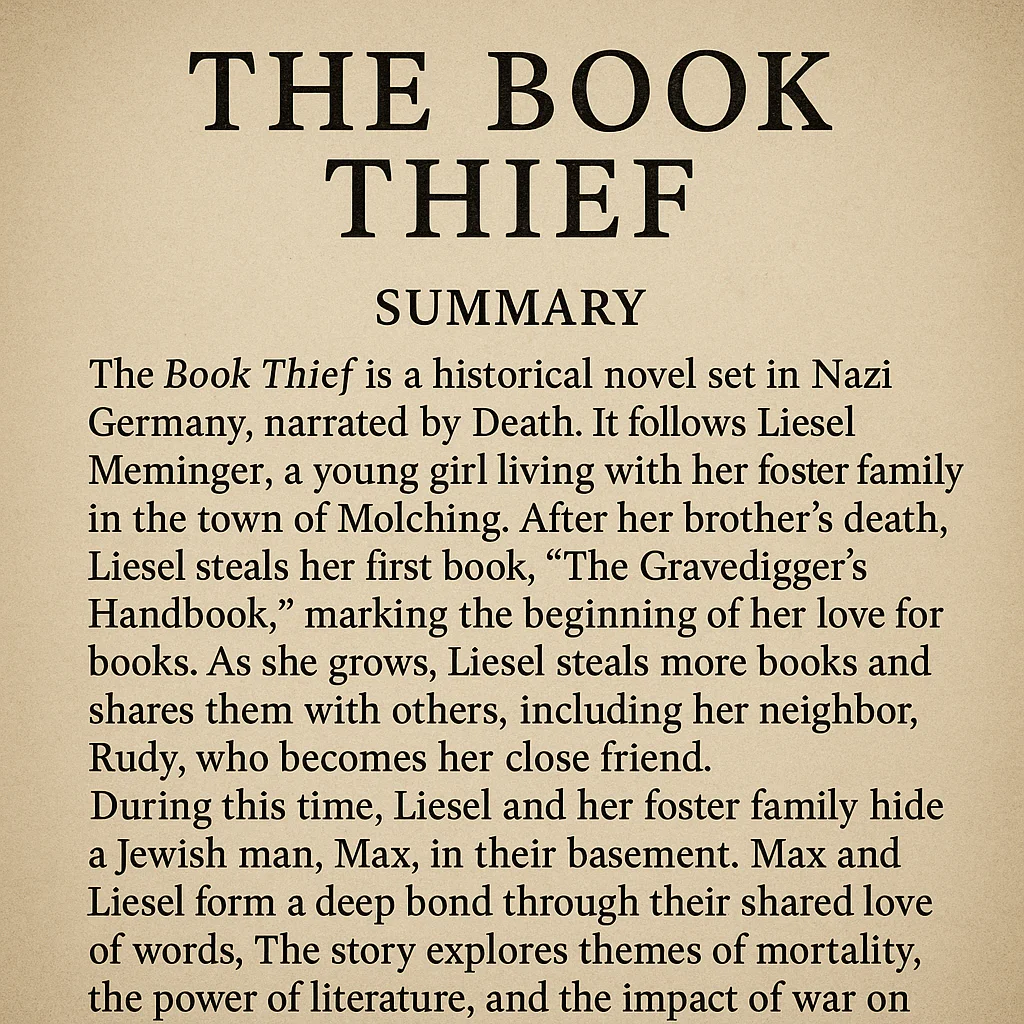
The plot follows Liesel Meminger, a young girl sent to live with foster parents, Hans and Rosa Hubermann, in the fictional town of Molching. After her brother dies on the train ride there, she steals her first book: The Gravedigger’s Handbook. This isn’t just a random theft; it’s her first attempt to grasp control in a life where she has none.
As the story progresses, Liesel learns to read with Hans, a kind accordion player who teaches her that words are not just ink on paper, but tools for connection. She befriends Rudy Steiner, a boy with a heart of gold and a obsession with Jesse Owens. Together, they steal food, play soccer, and eventually, steal books.
But the stakes rise when a Jewish refugee, Max Vandenburg, is hidden in their basement. Max and Liesel form a bond that transcends their circumstances, bonding over words and the shared fear of the outside world. Max teaches Liesel that “words are life.”
The narrative arc is a journey from illiteracy to literacy, from fear to courage, and from isolation to community. It asks us: If the world is ending, what do you hold onto? For Liesel, the answer is the book she is writing.
🎭 Beyond the Plot: A Deep Dive into The Book Thief Themes
While the plot is the skeleton, themes are the blood and soul of the story. If you’ve read the LitCharts summary, you know they identify several key themes. But we’re going to go deeper, exploring 10 distinct thematic pillars that make this book a masterpiece.
1. The Destructive and Redemptive Power of Words
This is the beating heart of the novel. The Nazis used words to dehumanize, to incite hate, and to justify genocide. Hitler’s speeches were weapons. But Liesel and Max use words to heal, to comfort, and to resist.
- Destructive: The book burnings, the propaganda, the names stripped from people.
- Redemptive: Hans reading to Liesel, Max painting over Mein Kampf to write new stories, Liesel reading to the townspeople in the basement during the air raid.
- The Insight: Words are neutral until given intent. The same tool that builds a wall can also build a bridge.
2. The Dual Nature of Humanity: Good vs. Evil in Nazi Germany
The novel refuses to paint anyone as purely good or purely evil. Even the “good” characters have flaws.
- Hans Hubermann: A kind man who slaps Liesel in a moment of frustration.
- Rudy Steiner: A thief who steals food, yet is the most loyal friend Liesel has.
- Ilsa Hermann: The mayor’s wife, who is grieving and distant, yet provides Liesel with a library.
- The Insight: As one source notes, “nobody in this novel tells the entire truth.” Everyone is a mix of light and shadow. This complexity makes the story feel real, not like a fable.
3. The Silent Language of Death and Mortality
Death is the narrator, but he isn’t the villain. He is a witness. He is “afraid of us” because he sees the worst of humanity. Yet, he is also “haunted by us” because he sees the best.
- The Metaphor: Death uses colors (white, black, red) to distract himself from the horror.
- The Insight: Mortality gives life its urgency. Because everyone dies, every act of kindness becomes precious.
4. The Transformative Strength of Empathy and Kindness
In a world of cruelty, small acts of kindness become revolutionary.
- Example: Hans giving bread to a Jewish man on the street, risking his life.
- Example: Liesel sharing her food with Max.
- The Insight: You don’t need an army to fight evil; you just need a loaf of bread and a kind word.
5. The Rebellion of the Soul Against Oppression
Stealing a book in Nazi Germany is an act of defiance. It’s a way of saying, “You cannot control my mind.”
- The Act: Max painting over Mein Kampf is the ultimate rebellion. He takes the symbol of the regime and turns it into a canvas for his own story.
- The Insight: Storytelling is a form of resistance.
6. The Unbreakable Bond of Found Family
Liesel loses her biological family, but she gains a found family in the Hubermanns.
- Dynamics: Rosa is tough and loud, but deeply loving. Hans is gentle and patient.
- The Insight: Family isn’t just about blood; it’s about who stays with you when the world falls apart.
7. The Role of Storytelling as Survival
Liesel writes her story to survive. It’s her way of processing trauma.
- The Climax: She is in the basement writing when the bombs fall. Her words are the only thing that remains.
- The Insight: We tell stories to make sense of chaos.
8. The Fragility of Innocence in a War-Torn World
Liesel and Rudy are children, but they are forced to grow up too fast.
- The Tragedy: Rudy’s death is a stark reminder that innocence has no shield against war.
- The Insight: The loss of innocence is the cost of war.
9. The Paradox of Life and Death Coexisting
Death is present in every scene, yet life is happening right next to him.
- The Scene: The book burning is a celebration of death, but Liesel is stealing a book of life.
- The Insight: Life and death are intertwined; one cannot exist without the other.
10. The Power of Small Acts of Defiance
You don’t have to be a hero to make a difference.
- The Act: Hiding Max in the basement.
- The Insight: Small acts can ripple out and change the world.
👤 Character Arcs: How Liesel Meminger Defines the Story’s Message
Liesel Meminger is not just a character; she is the embodiment of the book’s message. Her journey from a traumatized, illiterate girl to a writer who understands the power of words is the story’s backbone.
- The Beginning: Liesel is silent, grieving, and afraid. She steals the Gravedigger’s Handbook because she doesn’t know what else to do.
- The Middle: Under Hans’s tutelage, she learns to read. She finds her voice. She steals books not out of greed, but out of a need to understand the world.
- The End: She writes her own story. She realizes that while people die, words live on.
Rudy Steiner is equally crucial. His character arc is a tragedy of wasted potential. He is the “Jesse Owens” of the story, a boy who dreams of greatness in a world that denies him. His death is the emotional anchor of the book, reminding us of the cost of war.
Max Vandenburg represents the silenced voice of the Jewish people. His relationship with Liesel shows that connection can transcend race and religion. His act of painting over Mein Kampf is a powerful symbol of reclaiming one’s narrative.
🗣️ The Narrator’s Voice: Why Death Tells the Story
Why would an author choose Death as the narrator? It’s a bold choice, and it serves several purposes:
- Objectivity: Death is not human, so he can observe without bias. He sees the good and the bad equally.
- Foreknowledge: We know everyone dies. This creates a unique tension. We aren’t wondering if someone will die, but how they will live until then.
- The Human Perspective: Death is “haunted by humans.” He is fascinated by our capacity for both cruelty and kindness. This makes him a sympathetic narrator, not a cold one.
As the author explains, Death uses colors to cope with the horror. This adds a poetic layer to the narrative, making the grim subject matter more bearable and beautiful.
📚 Symbolism Decoded: Books, Snow, and the Color of the Sky
The symbolism in The Book Thief is rich and layered. Let’s decode the most important ones:
- Books: They represent knowledge, freedom, and resistance. Stealing a book is an act of reclaiming power.
- Snow: Often associated with purity and silence, but also with death and cold. The snow covers the blood, hiding the horror.
- The Colors (White, Black, Red): These are the colors of the Nazi flag, but Death sees them in the sky. This links the natural world to the political horror of the era.
- The Basement: A place of safety and confinement. It’s where Liesel and Max bond, but it’s also where they hide from the world.
💡 Quick Tips and Facts: Essential Takeaways for Readers
Before we wrap up the main analysis, here are some pro-tips for getting the most out of The Book Thief:
- Read the Footnotes: Zusak includes footnotes that add depth and context. Don’t skip them!
- Pay Attention to the Colors: Notice how the sky changes color in different scenes. It’s a clue to the mood.
- Listen to the Rhythm: The prose is poetic. Read it aloud to hear the rhythm of the words.
- Don’t Rush: This is a slow-burn story. Let the emotions sink in.
For more insights on how to analyze literature, check out our Classic Literature category.
🏆 Conclusion: Why The Book Thief Remains a Masterpiece

So, what is the main idea of The Book Thief? It is a testament to the resilience of the human spirit. It tells us that even in the darkest of times, words can save us. It reminds us that kindness is a form of rebellion, and that storytelling is a way to defeat death.
Liesel’s journey teaches us that we are all haunted by the past, but we can choose to write our own future. The book is a reminder that while we cannot control the world, we can control how we respond to it.
Why you should read it:
- ✅ Unique Perspective: Death as a narrator is unforgettable.
- ✅ Emotional Depth: It will make you cry, laugh, and think.
- ✅ Timeless Message: The power of words is as relevant today as it was in 1930s Germany.
Final Recommendation:
If you are looking for a book that will stay with you long after you turn the last page, The Book Thief is it. It’s not just a story about a girl stealing books; it’s a story about stealing back your humanity.
🔗 Recommended Links for Further Reading
Ready to dive deeper? Here are some resources to help you explore the world of The Book Thief and similar works:
- 👉 Shop The Book Thief on:
- Amazon | Barnes & Noble | Book Depository
- 👉 Shop The Book Thief (Audiobook) on:
- Audible | Amazon
- Explore Similar Historical Fiction:
- Shop All the Light We Cannot See on Amazon
- Shop The Nightingale on Amazon
❓ FAQ: Your Burning Questions About The Book Thief Answered
What is the main theme of The Book Thief?
The main theme is the dual nature of words. They can be used to oppress and destroy (Nazi propaganda) or to comfort and save (Liesel’s storytelling). It also explores the duality of human nature, showing that even in the worst of times, people are capable of both great cruelty and great kindness.
What is the central message of The Book Thief?
The central message is that storytelling is a form of resistance. In a world where words are used to dehumanize, using them to connect, comfort, and create is an act of defiance. It also suggests that humanity persists even in the face of overwhelming evil.
What is the plot summary of The Book Thief?
The story follows Liesel Meminger, a young girl in Nazi Germany who is sent to live with foster parents. She steals books to cope with her trauma and learns to read. She befriends a Jewish man, Max, who hides in her basement. The story is narrated by Death, who witnesses the lives and deaths of the characters. The climax occurs when the town is bombed, and Liesel survives by writing her story in the basement.
What is the significance of the title The Book Thief?
The title refers to Liesel, who steals books throughout the story. However, it also has a deeper meaning: she is stealing back the power of words from the Nazis. She is reclaiming the narrative, turning the tools of oppression into tools of survival.
Who is the narrator in The Book Thief and why does it matter?
The narrator is Death. This choice matters because it provides a unique perspective on the events. Death is not human, so he can observe the good and bad equally. He is “haunted by humans,” which adds a layer of empathy to the story. It also creates a sense of inevitability, as we know everyone dies, but we focus on how they live.
Read more about “What Is *The Book Thief* About? A Spoiler-Free Guide 📚 (2026)”
What is the moral of The Book Thief?
The moral is that kindness and storytelling can save us. Even in the darkest of times, small acts of kindness and the power of words can make a difference. It teaches us to value our humanity and to use our voices for good.
How does death function as a character in The Book Thief?
Death is a character who is curious, weary, and haunted by humanity. He is not the villain; he is a witness. He uses colors to cope with the horror he sees. His presence reminds us of the fragility of life and the importance of living fully.
📚 Reference Links and Sources
To ensure the accuracy of our analysis, we have consulted the following reputable sources: